











The open-source AI agent space has produced three breakout projects in under six months, and each one solves a different problem most teams have been quietly struggling with. OpenClaw crossed 295,000 GitHub stars by April 2026, briefly overtaking React on the all-time star rankings.
Paperclip hit 38,000 stars in under four weeks after its March 2026 launch. And Hermes Agent, released by Nous Research in February 2026, sits north of 90,000 stars with the strongest learning architecture of the three.
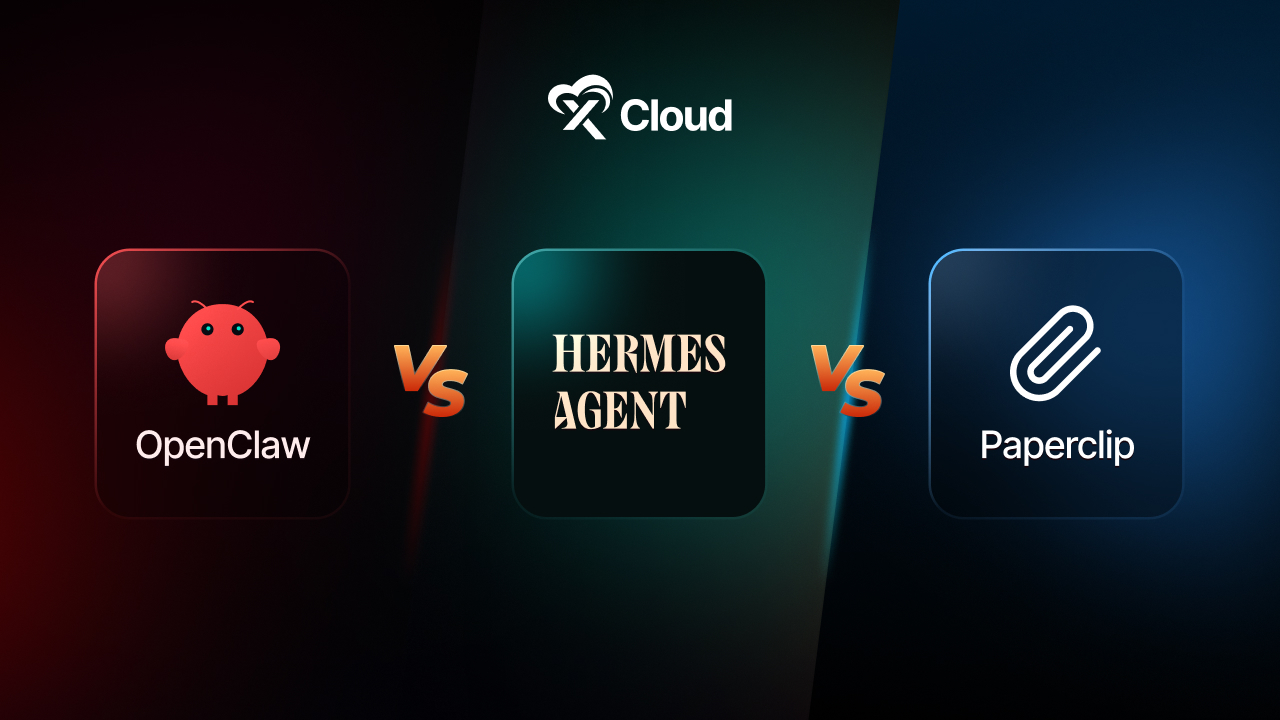
This guide is for developers, founders, and power users trying to figure out which one to actually run and where each fits in a real workflow.
Quick Summary / TL;DR
Too Long; Didn’t Read? Here’s the decision table you came for:
| If You Want To… | Use This | Best For | Setup Time |
|---|---|---|---|
| Run one personal AI assistant across Telegram + WhatsApp | OpenClaw | Solo operators, power users | 30 min – 2 hrs |
| Coordinate a team of AI agents like a company | Paperclip | Multi-agent operators, agencies | 1 – 3 hrs |
| Build a single agent that learns and remembers forever | Hermes Agent | Workflow automation, repeat tasks | 15 – 60 min |
| Skip the infrastructure pain entirely | Managed hosting | Anyone who just wants it to work | 5 min |
- Expert consensus from The New Stack: OpenClaw and Hermes Agent represent the shift from session-based AI tools toward persistent agent runtimes. Paperclip operates at a different layer entirely — it orchestrates the agents themselves.
- Best for Solo Operators: OpenClaw — 25+ messaging channels and the largest community skill ecosystem
- Best for Multi-Agent Coordination: Paperclip — org charts, budgets, governance, and atomic task execution
- Best for Workflow Learning: Hermes Agent — the only one with a built-in learning loop that creates skills from experience
If running any of them on a VPS sounds like a weekend you don’t have, xCloud provides one-click managed hosting for all three at $9.99/month, which is what the rest of this comparison assumes is the alternative to self-hosting.
Why These Three Platforms Are Reshaping AI Agent Hosting in 2026
The AI agent space was split into three distinct layers in early 2026, and each of these projects owns one. According to The New Stack’s analysis, the industry is moving from “session-based AI tools” toward “persistent agent runtimes” — a shift comparable to the move from stateless containers to long-running services.
According to Fortune, OpenClaw drew 2 million visitors in a single week in February 2026, and creator Peter Steinberger received praise from OpenAI’s Sam Altman, who called him a “genius with a lot of amazing ideas.” Hermes Agent came from Nous Research, the lab behind the Hermes, Nomos, and Psyche model families. Paperclip was built by pseudonymous developer @dotta after, in his own words, opening “20 or 30 Claude Code windows” and losing track of what each one was doing.
The three projects answer three different questions:
- OpenClaw answers, “How do I get an AI assistant onto every messaging app I use?”
- Paperclip answers, “How do I run a team of AI agents without losing my mind to context-switching and runaway token costs?”
- Hermes Agent answers, “How do I get an agent that actually learns from yesterday instead of starting fresh every conversation?”
You probably need one of these. You almost certainly don’t need all three.
How We Compared These Platforms
This comparison ranks each platform across six categories that determine real-world usability:
- Architecture and design philosophy — what the project is actually trying to be
- Adoption signals — GitHub stars, forks, community activity, third-party integrations
- Setup complexity — what it takes to go from
git cloneto a running agent - Capability depth — memory, skills, channels, tools, scheduling
- Operational reality — security, updates, debugging, support
- Cost to run — server costs, token costs, time costs
Adoption metrics are pulled from official repositories, Wikipedia, The New Stack, Fortune, Medium, and project blogs. Setup and operational notes come from production users on Reddit’s r/openclaw community, the Paperclip GitHub discussions, and the Hermes Agent docs site.
Master Comparison Matrix: OpenClaw vs Paperclip vs Hermes
The table below covers the practical differences a developer or operator needs to make a decision. Where numbers conflict between sources (which they do, because all three are growing fast), the more recent number is used.
| Rank | Platform | Category | GitHub Stars | Language | Best For |
|---|---|---|---|---|---|
| 🥇 | OpenClaw | Personal AI gateway | ~295,000+ | TypeScript | Multi-channel solo agents |
| 🥈 | Hermes Agent | Self-improving agent | ~90,000+ | Python | Repeat workflows, learning loops |
| 🥉 | Paperclip | Agent orchestration | ~43,000+ | Node.js + React | Teams of agents, budget control |
Critical context: these three are not direct competitors. The accurate framing, repeated by Flowtivity’s analysis and the Paperclip team itself: “If OpenClaw is the employee, Paperclip is the company.” Hermes is a third employee with a notebook that never empties.
🥇 OpenClaw — Best for Personal AI Gateway Across Every Messaging App
According to Wikipedia, OpenClaw was first published in November 2025 under the name Clawdbot, then briefly renamed Moltbot after trademark complaints from Anthropic, before settling on its final name on January 30, 2026.
The numbers tell the rest: in less than six months, it crossed 295,000 GitHub stars, briefly making it the most-starred open-source project in history before stabilizing in the same range as Linux. Fortune reported the project drew 2 million visitors in a single week, and creator Peter Steinberger joined OpenAI in February 2026 while transferring stewardship to a non-profit foundation.
What makes OpenClaw special is its reach. The Gateway process supports different messaging channels such as WhatsApp, Telegram, Slack, Discord, Google Chat, Signal, iMessage, BlueBubbles, IRC, Microsoft Teams, Matrix, Feishu, LINE, Mattermost, Nextcloud Talk, Nostr, Synology Chat, Twitch, Zalo, WeChat, QQ, and WebChat — over 25 channels from a single deployment. No other open-source agent comes close on this dimension.
Key Features
- 25+ messaging channels from one Gateway process — the broadest channel coverage of any agent
- Skills system — directories with a SKILL.md file that the agent loads as instructions; can be bundled, global, or workspace-scoped
- Local-first architecture — your conversations, credentials, and data stay on your hardware unless you connect a cloud LLM
- Plugin and extension ecosystem — third-party integrations from the community, including Google Meet, browser automation, and image generation
- Multi-agent routing — the Gateway can fan messages out to multiple agents like Pi, Claude Code, or Codex
How to Get Started with OpenClaw
Getting started is straightforward if you’re comfortable with a terminal. Two paths exist:
Option A: Self-Host (Free, Technical)
- Install Node 22.14+ or Node 24
- Run
npx openclaw onboardand follow the guided setup - Configure your LLM provider API key (Anthropic, OpenAI, or any compatible endpoint)
- Pair your messaging channel of choice (Telegram is fastest)
- Open the browser Control UI to manage sessions and skills
Option B: Managed Hosting ($9.99/month, Five Minutes)
If you don’t want to run a 24/7 process on your laptop or fight with Docker, xCloud’s OpenClaw Hosting deploys a managed instance in about five minutes with SSL, backups, and security patches handled. The OpenClaw mainstream documentation acknowledges that misconfigured self-hosted instances have caused security incidents like ClawHavoc, which is one reason managed hosting has become the default for non-developers.
Detailed Guides:
Pros and Cons
| Pros | Cons |
|---|---|
| ✅ The widest messaging channel support of any open-source agent | ❌ Default permissions are broad; misconfigured instances are a real security risk |
| ✅ Massive community, weekly releases, the largest skill ecosystem | ❌ Setup learning curve is front-loaded — Docker, Node, channel pairing |
| ✅ Local-first by design — your data stays on your machine | ❌ Some skills are unvetted; Cisco’s AI security team flagged data exfiltration in third-party skills |
| ✅ Multi-agent routing built in — works as a hub for other agents | ❌ Update cadence is so fast that breaking changes do happen |
Best for: Solo operators, power users, and developers who want one agent that reaches them everywhere — and are comfortable maintaining infrastructure or running it on managed hosting like xCloud OpenClaw Hosting.
🥈 Hermes Agent — Best for Workflows That Should Get Better Over Time
According to Nous Research, Hermes Agent is “the only agent with a built-in learning loop.” That isn’t marketing copy — it describes a specific architectural choice. After every task, Hermes distills what worked into a reusable skill, refines that skill the next time it gets used, and stores the result in persistent memory tied to your user model.
The project launched in February 2026 and has crossed 90,000 GitHub stars, with 12,000+ forks. The New Stack noted that while Hermes is smaller than OpenClaw in raw star count, the architecture underneath represents a different — and arguably more durable — bet on what AI agents should be.
Key Features
- Three-layer memory — active memory in MEMORY.md/USER.md, session history in SQLite with FTS5 search, and procedural memory as portable skills
- Self-improving skills — agent autonomously creates new skills from successful problem-solving and refines them in use
- 15+ messaging platforms — Telegram, Discord, Slack, WhatsApp, Signal, Matrix, Mattermost, Email, SMS, DingTalk, Feishu, WeCom, BlueBubbles, Home Assistant
- 47 built-in tools — web search, browser automation, vision, code execution, file management, image generation, and more
- 6 terminal backends — local, Docker, SSH, Daytona, Singularity, Modal (the last two enable serverless persistence that hibernates when idle)
- 200+ supported models via Nous Portal, OpenRouter, OpenAI, NVIDIA NIM, MiMo, GLM, Kimi, MiniMax, and any OpenAI-compatible endpoint
How to Get Started with Hermes Agent
Hermes is the easiest of the three to install. The official docs put it at “60 seconds” with one curl command:
Option A: Self-Host (Free, Linux/macOS/WSL2)
- Run the install script:
curl -fsSL https://raw.githubusercontent.com/NousResearch/hermes-agent/main/scripts/install.sh | bash- Configure the LLM provider with
hermes setup(Nous Portal OAuth, OpenRouter key, or custom endpoint) - Start with
hermesto enter the interactive TUI - Optionally configure messaging gateways with
hermes gateway
Option B: Managed Hosting ($9.99/month)
xCloud’s Hermes Agent Hosting deploys Hermes on a dedicated VM with SSL, daily backups, the messaging gateway pre-configured, and security updates handled. The “your laptop must stay on 24/7” problem disappears, which matters more than people expect — Hermes only learns when it’s running.
Detailed Guides:
Pros and Cons
| Pros | Cons |
|---|---|
| ✅ The only agent with autonomous skill creation and self-improvement | ❌ Smaller community and skill ecosystem than OpenClaw |
| ✅ Three-layer memory makes it useful from day 1 to year 1 | ❌ Self-evaluation can be unreliable on edge cases |
| ✅ 60-second install and clean defaults | ❌ Manual edits to skills sometimes get overwritten by self-improvement |
| ✅ Supports 200+ models including local Ollama and vLLM | ❌ Smaller messaging channel coverage than OpenClaw (15+ vs 25+) |
Best for: Anyone running the same workflows repeatedly — content briefs, research, customer triage, summarization — where the agent getting better over time has measurable value. Especially good if you want one well-behaved assistant rather than a fleet, whether you self-host or deploy on xCloud Managed Hermes Agent Hosting.
🥉 Paperclip — Best for Running a Team of AI Agents Like a Company
Paperclip launched on March 2, 2026 and crossed 38,000 GitHub stars in under four weeks. Creator Dotta said in a public demo with Greg Isenberg that he built it because he kept “20 or 30 Claude Code windows open at once” and lost track of what each one was doing — a problem anyone running multiple agents recognizes immediately.
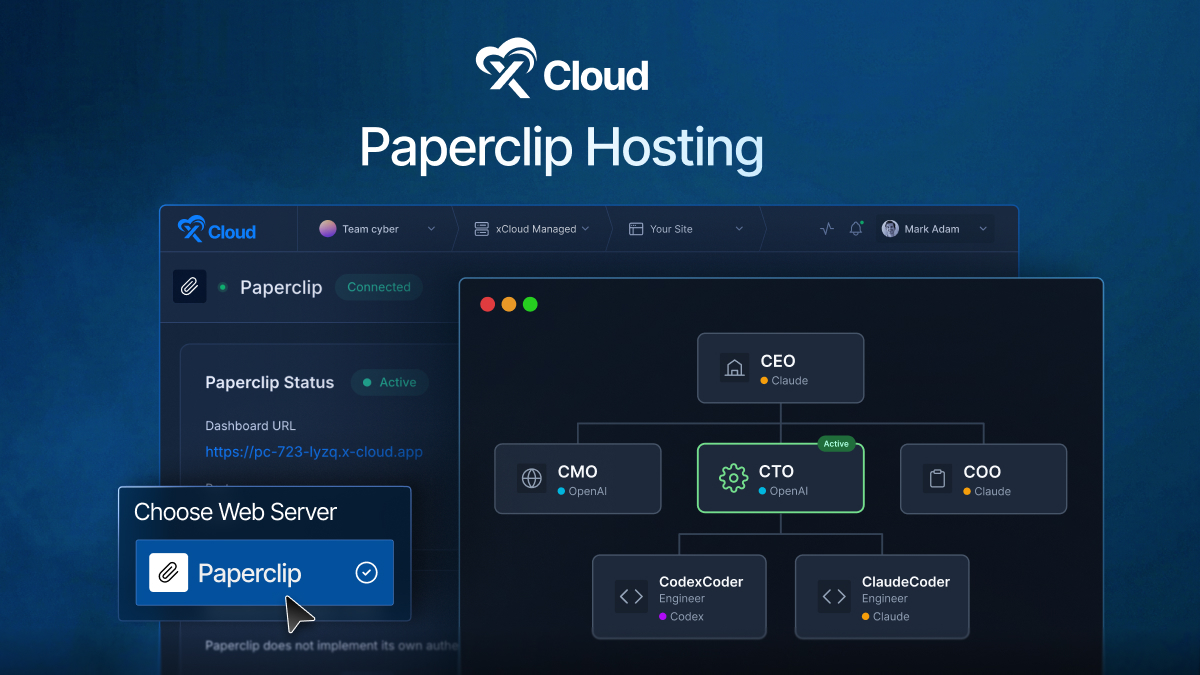
The architectural pitch is unusual: Paperclip is not an agent. It is the org chart, ticketing system, budget control, and governance layer that sits on top of other agents. As Flowtivity’s comparison puts it, “If OpenClaw is the employee, Paperclip is the company.” You hire OpenClaw, Hermes, Claude Code, Codex, or any custom agent into Paperclip, assign roles, set budgets, and let them coordinate.
Key Features
- Org charts and roles — define CEO, CTO, engineers, designers, marketers as agent positions; assign work down the hierarchy
- Atomic task execution — task checkout and budget enforcement happen atomically, so no double-work and no runaway spend
- Heartbeat scheduling — agents run on configurable schedules and event triggers, not always-on loops
- Multi-company isolation — one deployment can run unlimited companies with complete data isolation, useful for agencies or portfolio operators
- Bring-your-own-agent — works with OpenClaw, Hermes, Claude Code, Codex, OpenCode, or any HTTP webhook
- React dashboard — a Linear-style UI that operators have praised for design quality
How to Get Started with Paperclip
Paperclip is the most opinionated of the three to install — but all the steps are scripted.
Option A: Self-Host (Free, Local)
- Install Node 20+ (Postgres is embedded via PGlite, no Docker needed)
- Run the following code
npx paperclipai onboard --yes- Choose a bind preset (loopback for local, LAN, or Tailnet for shared access)
- Configure your first company, hire your first agent, assign your first task
Option B: Managed Hosting ($9.99/month)
xCloud’s Paperclip Hosting handles the Node.js + Postgres + reverse proxy + SSL stack so the operator can focus on org design rather than infrastructure. Per the Paperclip FAQ, Postgres setup, reverse proxy, and SSL “take time and technical knowledge” on a vanilla VPS — managed hosting compresses that to one click.
Detailed Guides:
Pros and Cons
| Pros | Cons |
|---|---|
| ✅ The first open-source platform with org charts, budgets, and governance for agents | ❌ Overkill for anyone running just one agent |
| ✅ Atomic task execution prevents runaway token spend | ❌ Token costs scale fast — Claude Code Max ($200/month) is practically required for serious use |
| ✅ Multi-company isolation is unique in the open-source space | ❌ No documented examples yet of fully autonomous companies running on Paperclip alone |
| ✅ React dashboard quality is genuinely Linear-level | ❌ CLI, environment variables, pnpm setup is not a no-code experience |
Best for: Operators already running 5+ agents who are losing track, agencies running multiple isolated client portfolios, or solo founders building toward an autonomous company stack. If that’s you, xCloud Paperclip Hosting handles the deployment so you can focus on the org chart instead of the database.
GitHub Growth Comparison: How Each Project Took Off
The growth curves for these three projects tell different stories. The table below summarizes their public adoption signals through April 2026.
| Project | Launched | Star Count by April 2026 | Time to 100K Stars | Forks | Primary Driver |
|---|---|---|---|---|---|
| OpenClaw | November 2025 | ~295,000 | ~2 months | 47,700+ | Multi-channel reach, viral renaming, Moltbook |
| Hermes Agent | February 2026 | ~90,000 | ~6 weeks | 12,000+ | Self-improving architecture, Nous brand |
| Paperclip | March 2026 | ~43,000 | Not yet hit | Growing | Multi-agent orchestration gap |
According to OpenClaw’s announcement post, the project went from a “WhatsApp Relay” weekend hack to 100,000 stars in two months. The 36Kr analysis attributes the breadth of adoption to a different go-to-market path than previous viral projects: where Vue, Go, and Kubernetes spread top-down through technical leadership, OpenClaw spread sideways across non-developers — design managers on phones, parents using WhatsApp family groups, students automating homework workflows.
Paperclip’s growth is rare in a different way. Most agent frameworks are built for developers; Paperclip is built for operators. The 47-minute live demo Dotta did with Greg Isenberg pulled in non-technical buyers — solo founders, agency owners, and what Dotta described as “dentists, roofers, and marketing firms” looking for AI worker dashboards.
Hermes has the most academic provenance. Nous Research’s reputation as the lab behind the Hermes, Nomos, and Psyche model families gave the agent immediate credibility with ML practitioners. Its growth is steadier than OpenClaw’s spike and Paperclip’s dashboard-driven adoption — closer to the slope of a research project that quietly becomes essential infrastructure.
Feature Comparison Matrix: What Each Platform Actually Does
| Feature | OpenClaw | Hermes Agent | Paperclip |
|---|---|---|---|
| Self-improving skills | ⚠️ Manual | ✅ Autonomous | ❌ N/A (orchestrates other agents) |
| Persistent memory | ✅ File-backed | ✅ Three-layer | ✅ Org-level |
| Messaging channels (built-in) | ✅ 25+ | ✅ 15+ | ❌ Dashboard-based |
| Multi-agent orchestration | ⚠️ Routing | ⚠️ Sub-agents | ✅ Org charts |
| Budget enforcement | ❌ External | ❌ External | ✅ Atomic |
| Heartbeat scheduling | ✅ Cron | ✅ Cron | ✅ Native |
| Local-first | ✅ | ✅ | ✅ |
| Skill ecosystem | ✅ Largest | ⚠️ Growing | ⚠️ Newest |
| Brings own model | ✅ Any | ✅ 200+ | ✅ Any (via agents) |
| Multi-company isolation | ❌ | ❌ | ✅ Native |
| Production maturity | ✅ Highest | ⚠️ Improving | ⚠️ Newest |
The pattern is clear: each platform is the leader in the dimension it was designed for and weaker on the dimensions it wasn’t. That’s a feature, not a bug — none of these projects is trying to be everything.
Implementation Difficulty: Self-Hosted vs Managed
| Platform | Self-Hosted Setup | Self-Hosted Maintenance | Managed (xCloud) Setup | Managed Maintenance |
|---|---|---|---|---|
| OpenClaw | 30 min – 2 hrs (Docker, Node, channel pairing) | High (frequent releases, security patches) | ~5 minutes | None |
| Hermes Agent | 15 – 60 min (one curl command + setup wizard) | Medium (smaller surface area) | ~5 minutes | None |
| Paperclip | 1 – 3 hrs (Node, Postgres, reverse proxy, SSL) | Medium (Postgres health, agent governance) | ~5 minutes | None |
The recurring theme in the r/openclaw subreddit is that the hardest part of running an AI agent isn’t the agent itself, it’s the infrastructure. Docker setup, security hardening, 24/7 uptime, and breaking updates take more time than configuring the agent. That’s the gap xCloud is targeting: managed hosting at $9.99/month for any of the three and with the same 14-day money-back guarantee.
Cost Breakdown: What You’ll Actually Pay
Real costs for an open-source AI agent are split into three buckets: server, LLM tokens, and your time.
| Cost Bucket | OpenClaw | Hermes Agent | Paperclip |
|---|---|---|---|
| Server (self-hosted VPS) | $5 – $20/month | $5 – $20/month | $10 – $40/month (Postgres) |
| Server (managed via xCloud) | $9.99/month | $9.99/month | $9.99/month |
| LLM tokens (light use) | $5 – $30/month | $5 – $30/month | $30 – $200/month |
| LLM tokens (heavy use) | $100 – $500/month | $100 – $500/month | $500 – $2,000/month |
| Your time (self-hosted, ongoing) | 2 – 5 hrs/month | 1 – 3 hrs/month | 2 – 6 hrs/month |
| Your time (managed) | ~0 hrs/month | ~0 hrs/month | ~0 hrs/month |
Paperclip costs more on tokens because it runs multiple agents in parallel — that’s the whole point. The Paperclip team has been honest that Claude Code Max ($200/month) is “practically required” for any serious multi-agent setup, which is a real cost most comparisons skip.
Common Mistakes When Choosing Between These Platforms
The three most common errors I’ve seen in production deployments and Reddit threads:
- Mistake 1: Picking Paperclip when you only need one agent. Paperclip’s value scales with the number of agents you run. If you have one agent, Paperclip is overhead — use OpenClaw or Hermes directly.
- Mistake 2: Picking OpenClaw when you only need workflow automation. OpenClaw’s strength is multi-channel reach. If you mostly automate the same five tasks every week and don’t care about Telegram or WhatsApp, Hermes Agent’s learning loop will do more for you over six months.
- Mistake 3: Self-hosting any of them while learning AI agents. The Reddit consensus is unambiguous: infrastructure is the hardest part of running these tools, harder than configuring the agents. Until you understand what your agent should actually do, paying $9.99/month for xCloud’s managed hosting on whichever platform you pick is the lower-cost path.
- Mistake 4: Treating all three as competitors. They run at different layers. The mature stack is OpenClaw or Hermes as the worker, Paperclip as the manager – not “pick one of three.”
Audience Mapping: Which One Fits You?
| Your Goal | Best Choice | Expected Setup | Why |
|---|---|---|---|
| One AI assistant on Telegram + WhatsApp | OpenClaw | 5 min managed / 1 hr self-hosted | Widest channel coverage |
| Workflow automation that improves over time | Hermes Agent | 5 min managed / 30 min self-hosted | Self-improving skills |
| Coordinating 5+ agents toward shared goals | Paperclip | 5 min managed / 2 hrs self-hosted | Org charts + budgets |
| Building an autonomous AI company | Paperclip + OpenClaw/Hermes | Compound | Manager + workers |
| Running an agency with multiple client orgs | Paperclip | 5 min managed | Multi-company isolation |
| Personal productivity, occasional tasks | Hermes Agent | 5 min managed | Cleanest defaults |
| Deepest customization and largest skill library | OpenClaw | 5 min managed | Largest ecosystem |
| Just want to try AI agents without setup | Any (managed) | 5 min | Zero infrastructure |
Frequently Asked Questions
Which AI agent platform should I start with?
If you want a single AI assistant that reaches you on every messaging app, start with OpenClaw. If you mostly automate the same workflows and want them to improve, start with Hermes Agent. If you’re already running multiple agents and losing track, start with Paperclip on top of whichever agent you already have. There is no universal “best” — the Rahul Goyal review lands on the same answer: pick by use case, not popularity.
Are these three platforms competitors?
No, despite often being compared together. OpenClaw and Hermes Agent are agents (workers). Paperclip is an orchestration layer (manager). The mature production setup uses one of the agents inside Paperclip’s company structure. Flowtivity’s analysis explains this distinction in detail.
Do I need Docker or DevOps experience to run them?
For self-hosting, yes — all three require comfort with a terminal, Node.js or Python environments, and at least basic networking knowledge. For managed hosting via xCloud, no — the platforms are deployed and updated for you, which is why the documentation explicitly recommends managed hosting for non-developers.
How long does deployment take?
Self-hosted: OpenClaw and Paperclip take 30 minutes to 2 hours, Hermes Agent takes 15-60 minutes. Managed via xCloud: roughly 5 minutes for any of them, including SSL, backups, and channel pre-configuration.
Is my data private with these tools?
All three are local-first or self-hostable, so your data stays on your own server. None of them phone home unless you explicitly configure cloud LLM providers (which all of them require for actual reasoning). The Hermes Agent documentation is explicit about zero telemetry by default.
What’s the budget needed for serious daily use?
For one agent (OpenClaw or Hermes) on managed hosting with moderate LLM usage, budget $50-$80/month total. For Paperclip running 5+ agents with Claude Code, budget $250-$500/month. Self-hosting reduces the server cost but adds your time as a real expense.
Will these work for non-developers?
Hermes Agent is the most accessible of the three. OpenClaw has the steepest learning curve due to its breadth. Paperclip is operator-friendly through its dashboard but technical for setup. All three become non-technical experiences when deployed via managed hosting.
What’s the most underrated platform?
Paperclip — most coverage focuses on OpenClaw and Hermes as competing agents, but Paperclip is solving a problem (multi-agent coordination) that almost nobody else in the open-source space has touched. SOTAAZ’s review called it “the first to offer org charts, budget management, governance, and audit logs as open source.”
How often should I update?
OpenClaw releases multiple versions per week and breaking changes do happen — pin a version for production use. Hermes Agent has a slower, more curated release cadence. Paperclip is on rapid development as a new project. Managed hosting handles all of these update cycles automatically.
Can I run these on the same server?
Yes. A single VPS can host any combination, though you’ll want to scope memory and CPU for each. Running all three on the same managed server is supported on xCloud’s $9.99/month plan, which includes app deployment for multiple services.
What about security risks?
OpenClaw has had public security incidents, including ClawHavoc (a malicious skill package campaign) and remote code execution flaws. Cisco’s AI security team flagged data exfiltration in third-party skills. Hermes Agent’s smaller skill ecosystem and simpler architecture have a smaller attack surface. Paperclip orchestrates other agents, so its risks are governance-related — runaway agents, budget overruns — rather than infrastructure-level. For all three, isolated deployment (Docker, dedicated VPS, or managed hosting) reduces risk substantially.
Where can I get help if something breaks?
OpenClaw has the biggest community — Discord, GitHub Discussions, and r/openclaw on Reddit (103,000+ members). Hermes Agent has Nous Research’s Discord and GitHub. Paperclip has GitHub Discussions and a smaller, faster-moving community. For managed hosting users, xCloud provides 24/7 expert support with average response times under four hours.
Your 2026 AI Agent Roadmap
The AI agent market split into three distinct layers in early 2026, and the top open-source project at each layer is now clear. OpenClaw owns the personal gateway. Hermes Agent owns the self-improving runtime. Paperclip owns multi-agent orchestration. None of them is a complete substitute for the others, and most production users will end up running two of them together — Paperclip on top of OpenClaw or Hermes — within the next twelve months.
Expert Picks by Goal
| Your Goal | Best Choice | Expected Impact |
|---|---|---|
| Best Overall ROI | Hermes Agent | Skills compound over time; cleanest defaults |
| Best for Beginners | Hermes Agent (managed) | 5-minute deploy, lowest friction |
| Best for Quick Wins | OpenClaw (managed) | Live on Telegram in 5 minutes |
| Best for Multi-Agent Operators | Paperclip + OpenClaw/Hermes | Org-level coordination |
| Best for Multi-Channel Reach | OpenClaw | 25+ channels from one Gateway |
| Best for Repeat Workflows | Hermes Agent | Procedural memory + skill evolution |
| Best for Agency / Portfolio Use | Paperclip | Multi-company isolation native |
| Best for Skipping Infrastructure | Any on xCloud | $9.99/month, 5-minute deploy |
What to do this week: Pick the layer that matches your problem (gateway, runtime, or orchestration), deploy the matching platform on managed hosting if you don’t want to fight infrastructure, and give it 14 days of real workflows before deciding whether to scale up. The 14-day money-back guarantee on xCloud’s managed plans gives you peace of mind to try without any stress.
The honest truth from six months of watching this space: the people getting the most out of AI agents in 2026 are not the ones who picked the trendiest project. They’re the ones who matched the platform to a problem and shipped it on infrastructure they don’t have to babysit. Whichever of these three you pick, that part is the one that matters.
If you have found this blog helpful, feel free to subscribe to our blogs for valuable tutorials, guides, knowledge and tips on web hosting and server management. You can also join our Facebook community to share insights and take part in discussions.