
















Website builders have existed since the earliest days of the web. In the 1990s, WYSIWYG tools such as Microsoft FrontPage and Adobe Dreamweaver allowed users to design websites visually rather than writing HTML by hand. Their arrival marked a major shift: for the first time, people without programming knowledge could design functional websites using drag-and-drop tools.
The next major evolution came with online builders in the mid-2000s. Squarespace, Weebly, and Wix brought web-based drag-and-drop editing, hosted infrastructure, and professional templates to everyday users. These services shaped what most people now think of as “website builders,” long before artificial intelligence entered the space.
Now, the scene is changing. Let’s see what website builders have to offer going into 2026 and the history of AI in website building platforms.
Brief history of AI in website builders
AI began appearing in website building tools in the mid-2010s, though early features were far from the generative AI we know today.
The first widely publicized attempt came in 2016, when Wix introduced ADI (Artificial Design Intelligence), which promised to build websites based on user questionnaires. The system relied heavily on templates and decision trees rather than true generative models, but it was a significant step in automation.
Through 2020 and 2021, as large language models became accessible, website builders started integrating AI-powered text generation. Wix added automated copywriting and SEO suggestions. Shopify, Squarespace, Webflow, and WordPress plugins adopted AI writing assistants to help users produce descriptions, blog posts, and headlines with minimal effort.
When image generators like DALL·E 2 and Stable Diffusion arrived in 2022, builders began offering AI image creation for hero banners, icons, and product photos. By 2024, several companies claimed they could produce entire websites from a single prompt, though results were typically generic and required significant manual refinement.
Downsides
Reality often didn’t meet user expectations. Many AI promises in 2023–2025 were marketed as “full website automation,” yet still produced outcomes reliant on rigid templates. Companies suggested that users could create full websites with zero effort, but in practice, the AI struggled to interpret brand identity, layout nuance, or complex business requirements.
Squarespace, despite being a major industry player, still lacked a truly autonomous AI builder. Its system mainly offered text generation and template recommendations rather than full-page editing or real-time manipulation.
Another issue was sameness. Because most tools generated variations of existing templates, AI websites looked highly similar. Users often ended up with generic designs that required manual editing to become unique or visually polished.
Editing with AI
A core limitation in early AI website builders was editing. AI could generate pages or sections, but it couldn’t operate inside the editor. It couldn’t move elements, adjust spacing, reshape structure, or modify properties in real time. Builders weren’t designed to allow external systems to manipulate canvas elements, so AI generation stopped at the starting point; humans had to take over from there.
This problem became apparent across the entire industry. Builders could boast about “AI websites,” but the AI couldn’t actually use the builder. That gap made many AI features redundant, as users still had to manually tweak most design decisions.
AI learns to operate website builders (2024–2026)
Starting in 2024 and accelerating through 2025, several companies began teaching AI to interact with website builders at a deeper level.
Shopify made headlines in May 2025 with an AI tool capable of generating a fully functional online store from keywords, including product pages, storefront layout, and navigation. This represented one of the first major commercial pushes into semi-autonomous website generation.
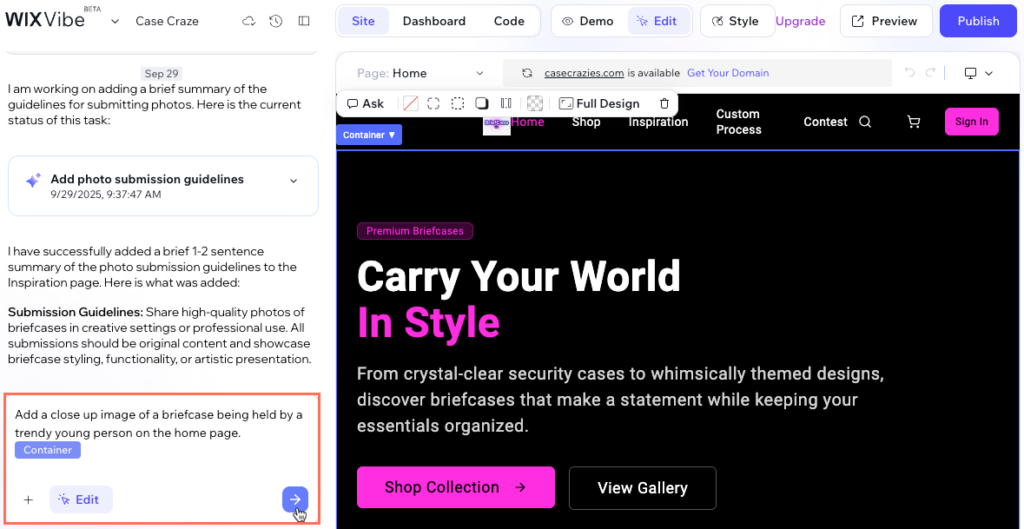
Wix introduced experimental internal systems designed to generate custom code for more advanced sites, while startups like Lovable focused on React code generation rather than design-time editing. These systems produced code rather than manipulating elements inside a visual editor, creating a gap between AI output and practical website-building workflows.
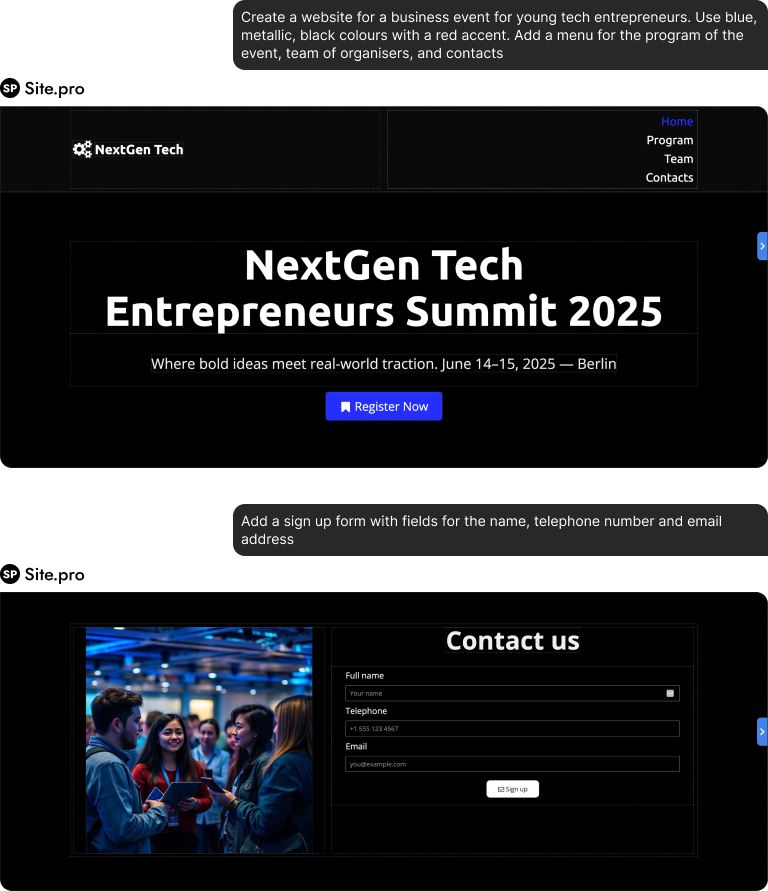
Site.pro took a broader approach, building AI directly into the editor so it could perform real actions rather than just propose content. By the end of 2025, the platform allowed users to generate entire page structures, add or remove components, move elements around the canvas, and replace images through text or voice commands. The AI understood the builder’s internal structure well enough to make precise changes, enabling an editing experience closer to working with a human assistant.
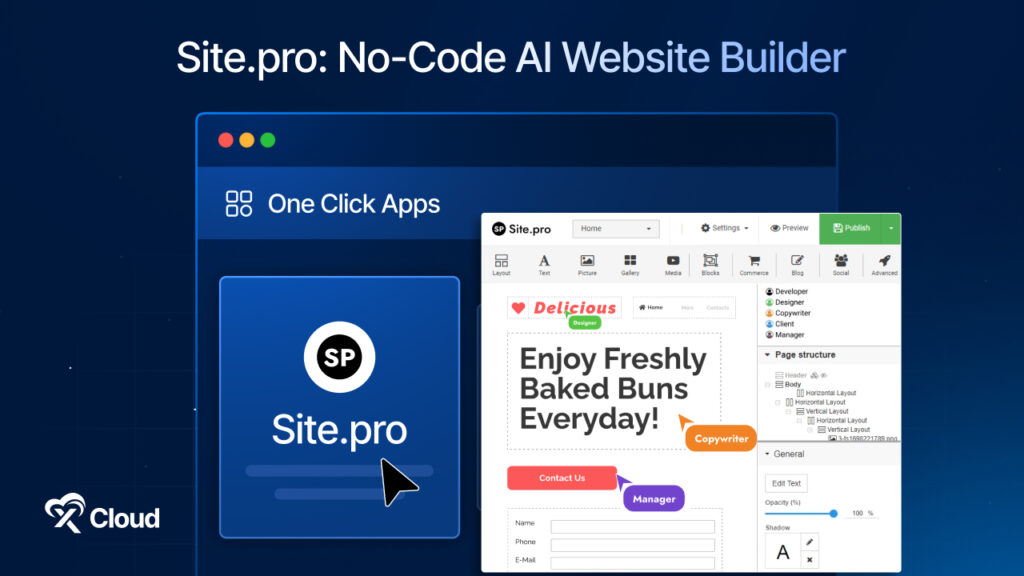
Site.pro also allowed multilingual voice input, making it one of the few website builders with hands-free AI editing. Users could prototype websites quickly, iterate multiple versions, and launch production-ready pages without deep technical knowledge. Site.pro website builder can be installed directly with xCloud, follow the documentation manual to do it easily.
Voice control and specialization
Voice-enabled website editing is still rare, but it is gradually appearing in modern builders. While tools like Wix’s AI Velo/Vibe or Lovable concentrate on generating functional code, and Shopify focuses on e-commerce flows, Site.pro positions itself as a general-purpose builder capable of responding to both typed and spoken commands.
Each company is taking a different approach:
- Shopify optimizes for store creation.
- Wix’s AI is oriented toward code and logic.
- Lovable generates full React applications.
- Site.pro focuses on real-time editing inside a visual builder.
This diversification shows that “AI website building” is not a single technology but an ecosystem of evolving approaches.
What to expect next?
Companies are moving toward AI that behaves more like a virtual web designer than a content generator. Site.pro has shared that its long-term direction involves AI capable of performing design tasks autonomously and instantly — in line with its philosophy of making all operations as fast as possible.
The next stage of AI-driven website creation likely includes:
- continuous real-time editing
- unique layouts unbound by templates
- agent-like assistants that maintain sites over time
- design decisions driven by user goals, not questionnaires
- instant multi-iteration prototypes generated on demand
By 2026, we’re transitioning from tools that create websites for users to AI agents that create and refine websites with users — blending automation, creativity, and human guidance in a way unseen in previous decades.