


To automate security updates on an xCloud server, you do not have to turn anything on for the operating system. Every xCloud server installs Ubuntu security updates by itself, once a day. From the server’s Security Update page you then choose two more things: whether the server reboots by itself when an update needs it, and whether it also updates the services xCloud installed, such as PHP and Node.js. This guide explains what is automatic, what is not, and how to set it up.
Why Automate Security Updates on a Server
Without timely updates, servers can pick up security risks, performance problems and potential downtime. On a traditional setup, an administrator has to watch for updates and install them by hand. On xCloud, the server installs eligible updates for you, so the window between a fix being released and installed gets shorter.
What xCloud Updates on Its Own
xCloud configures Ubuntu’s unattended-upgrades on every server it provisions. It installs Ubuntu security updates once a day, covering the kernel, OpenSSL, system libraries and the other operating system packages. This is always on and has no setting.
Some services do not come from Ubuntu, so Ubuntu’s updates do not reach them:
| Service | Updated automatically by default? | How to keep it patched |
|---|---|---|
| Ubuntu packages (kernel, OpenSSL, system libraries) | Yes | Nothing to do. Reboot when asked, or turn on Automatic Reboot |
| PHP and LiteSpeed PHP | No | Turn on Managed Service Updates, or patch from Management → Manage PHP |
| MySQL 8.4, MariaDB 11.8, Redis | No | Turn on Managed Service Updates |
| Node.js from NodeSource | No | Turn on Managed Service Updates, then check its row |
| NGINX from nginx.org, OpenLiteSpeed | No | No automatic updates. Contact support if you need a patch |
| Docker | No | Not included, because a Docker upgrade restarts every container |
Managed Service Updates is off by default. When you turn it on and pick an update time, the server installs updates for those services once a day and keeps each one on the series it already runs. The full table, including MySQL 8.0 and MariaDB 10.x, is in how to keep your server up to date with automated security updates. To check a single package, read how automated security updates and auto reboot work in xCloud.
How You Are Told a Reboot Is Needed
Some updates, most often kernel updates, only take effect after a reboot. When one is installed, xCloud tells you in two places:
- Email notification: an email says the server needs a reboot.
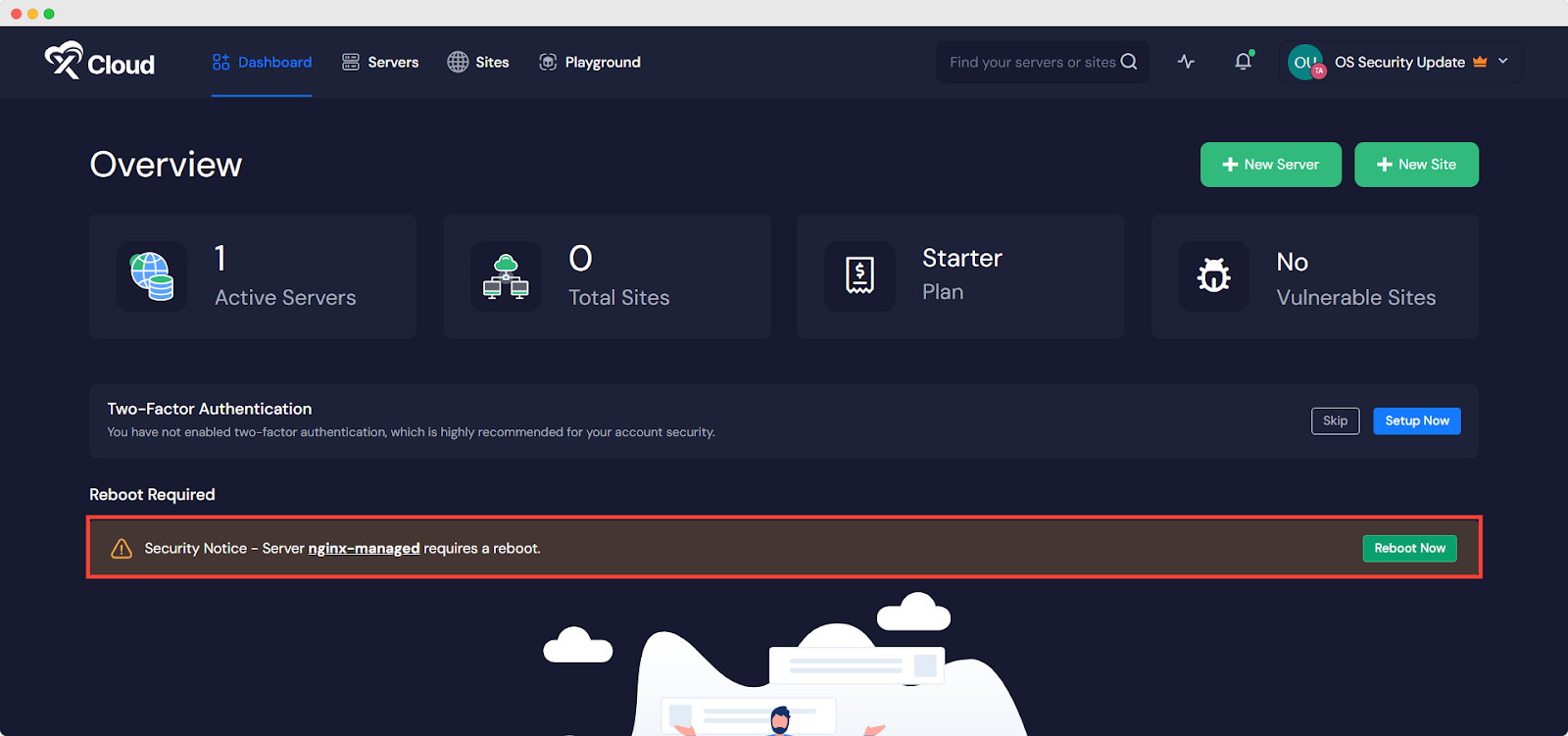
- Server notice: a notice appears on the server’s pages with a Reboot Now button. The Security Update page also shows a Reboot pending chip.
If you are not ready, you can Skip the notice for 3, 7 or 30 days, or choose Always Skip for that server. A Re-enable Notifications button turns it back on.
Step-by-Step: Set Up Automatic Reboots
Step 1: Open the Security Update Page
Log in to your xCloud dashboard, open your server and go to its Security Update page. If a reboot is pending, you see a notice with a Reboot Now button.
Step 2: Reboot Now, or Turn On Automatic Reboot
To apply the update yourself, click Reboot Now, check the list of updates and click Reboot. xCloud installs any pending security updates first, then restarts the server if a restart is still needed.
To let the server do it, turn on Automatic Reboot and choose a Reboot Time. The time uses the server’s configured timezone.
Step 3: Turn On Managed Service Updates (Optional)
Turn on Managed Service Updates and pick an update time if you want PHP, Node.js, Redis and the databases from their own repositories patched automatically too. Then click Save Settings.
Tip: Pick a low-traffic window. Your sites are briefly unavailable during a reboot, so test them afterwards.
Automatic Reboot Does Not Install Updates
Automatic Reboot only handles the last step. Ubuntu installs the update, marks a reboot as required, and xCloud restarts the server at your Reboot Time. It does not reboot on a schedule when nothing needs a reboot. One exception: saving the page with Automatic Reboot on and Managed Service Updates off installs pending Ubuntu security updates right away.
Other Features That Help Keep a Server Secure
- Monitoring and alerts: get server alerts through Slack and WhatsApp.
- Log viewer: open error and access logs to diagnose problems.
- File and database access: use SFTP for files and Adminer for databases.
- Security Center: see waiting server patches, old PHP versions and vulnerable plugins on one page. Read how to use the Security Center.
Frequently asked questions
Do automated security updates install PHP security patches?
Not by default. xCloud installs PHP from its own repositories, which Ubuntu’s security updates do not cover. Turn on Managed Service Updates on the server’s Security Update page, or install the patch from Management → Manage PHP with Scan Patch.
Does Automatic Reboot install updates?
No. The server installs security updates by itself. Automatic Reboot only decides whether the server restarts on its own, at your Reboot Time, when an installed update needs a reboot.
Does Automatic Reboot restart my server every day?
No. The server reboots at the selected time only when Ubuntu has marked a reboot as required. If nothing needs a reboot, nothing happens.
Will Managed Service Updates upgrade me to a new major version?
No. Each service stays on the series the server already runs, for example PHP 8.3 stays on 8.3 and Node.js 22 stays on 22.
If you have found this blog helpful, feel free to subscribe to our blogs for valuable tutorials, guides, knowledge, and tips on web hosting and server management. You can also join our Facebook community to share insights and engage in discussions.
Last updated November 5, 2026
← All articles