


Rybbit vs Plausible vs Umami comes down to how much you want to see. Umami is the lightest: one app and one database, with funnels and journeys included. Plausible gives the cleanest single-screen dashboard. Rybbit adds session replay, Web Vitals and error tracking in the free self-hosted version. All three are open source, cookieless and free to self-host.
You have decided Google Analytics is not worth the cookie banner. Now three names keep coming up, and every comparison you find was written before Rybbit grew up, or only covers the hosted plans.
We run all three as One Click Apps on xCloud, so this guide adds what most comparisons skip: what each install actually runs on your server, and what you must do in the first ten minutes to keep it safe. If you want the wider field first, our self-hosted analytics tools roundup ranks nine tools.
This post covers features, server needs, first login, cloud prices, and a clear rule for picking one.
TL;DR (Too Long, Didn’t Read?)
Short on time? Here is the whole guide in a few lines:
- Umami is the light option. One app plus a PostgreSQL database, MIT licence, no ClickHouse, and still funnels, journeys and retention reports.
- Plausible is the simple option. The cleanest one-screen dashboard, but funnels, user journeys and ecommerce revenue are cloud-only.
- Rybbit is the deep option. Funnels, journeys and retention plus session replay, Web Vitals and error tracking, all in the free self-hosted build.
- Rybbit and Plausible both need ClickHouse. xCloud asks for at least 2 GB of RAM for Rybbit and 4 GB for Plausible.
- The first login is the risky part. Rybbit leaves sign-up open, and Umami starts with the default login
admin/umami. - Cloud prices differ a lot. Umami Cloud has a free Hobby plan, Rybbit starts at $13/month billed annually, and Plausible keeps funnels for its Business plan (as of November 2026).
- On xCloud, all three are One Click Apps with your domain and free SSL set up for you.
The Finding: The Real Difference Is What Runs on Your Server
Feature lists make these three look close. The install tells a different story. Here is what each one runs, read from xCloud’s Rybbit and Plausible install settings and Umami’s own README in November 2026.
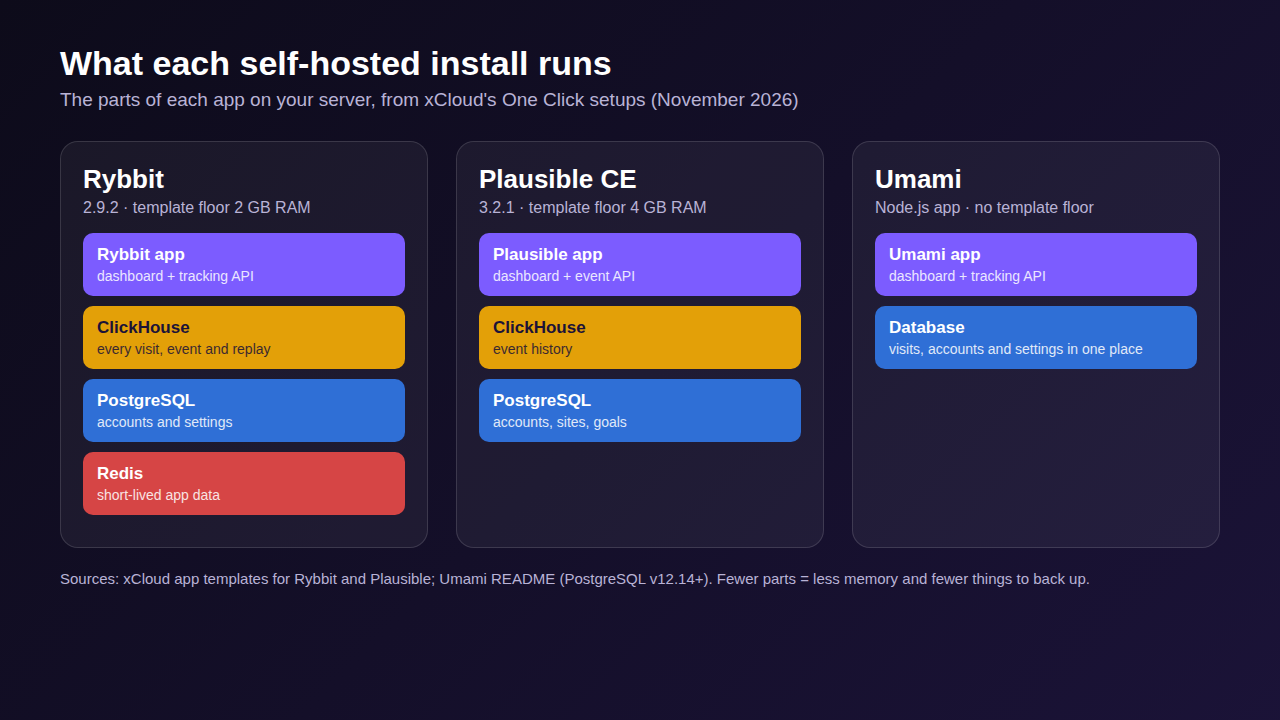
| Rybbit | Plausible CE | Umami | |
|---|---|---|---|
| Version on xCloud | 2.9.2 | 3.2.1 | Not fixed to a version |
| Parts on your server | App, ClickHouse, PostgreSQL, Redis | App, ClickHouse, PostgreSQL | App, PostgreSQL |
| Minimum RAM xCloud asks for | 2 GB | 4 GB | None set |
| Upstream RAM advice | “At least 2GB” | “At least 2 GB” recommended | Not stated |
| Install fields you fill in | None, passwords are generated | None, secrets are generated | Database name, user and password |
| What to back up | Three databases | PostgreSQL, ClickHouse and two data folders, together | One database |
If you only remember one line: every extra database is more memory to pay for and one more thing to back up. Umami has one. Rybbit has three.
The two ClickHouse tools are not heavy for no reason. ClickHouse is a database built for counting huge numbers of events quickly. It is why Rybbit can afford replay and funnels, and why Plausible stays fast on a busy site.
Rybbit vs Plausible vs Umami at a Glance
| Factor | Rybbit | Plausible CE (self-hosted) | Umami |
|---|---|---|---|
| Best at | Product-style analysis | A clean traffic dashboard | Light, general analytics |
| Licence | AGPL-3.0 | AGPL-3.0 | MIT |
| Cookies | None | None | None |
| Pageviews, sources, goals | ✅ | ✅ | ✅ |
| Custom events | ✅ | ✅ | ✅ |
| Funnels and user journeys | ✅ | ❌ Cloud only | ✅ |
| Retention | ✅ | ❌ | ✅ |
| Session replay | ✅ | ❌ | Listed on Umami Cloud Business |
| Web Vitals | ✅ | ❌ | ❌ |
| Script size | “11 KB” (Rybbit) | “54 times smaller than Google Analytics” (Plausible) | Not stated |
| Release pace | Regular GitHub releases | Community Edition “twice per year” | Regular GitHub releases |
Sources: rybbit.com, Plausible’s self-hosted page and the Umami README, all read 10 November 2026.
What Is Rybbit?
Rybbit is open-source, cookieless web and product analytics. It covers the Google Analytics basics, then adds autocapture, session replay, funnels, user journeys, retention, error tracking and Web Vitals.
It is the youngest of the three and moves fast. Our What Is Rybbit guide explains how it works and where it falls short.
What Is Plausible?
Plausible is a simple, privacy-friendly traffic dashboard. Everything important sits on one screen: visitors, sources, top pages, countries, devices and goals.
The self-hosted version is called Plausible Community Edition (CE). Plausible states that CE does not include “marketing funnels, user journeys, ecommerce revenue goals, SSO and sites API”, and that it is released “twice per year”.
What Is Umami?
Umami is privacy-first analytics that runs on very little. Its README describes traffic, campaigns, behavior, conversions and revenue in one place, with no cookies. Its docs add funnel (since v2.3.0), retention (since v2.5.0) and journey (since v2.12.0) reports.
It needs Node.js and a PostgreSQL database (v12.14 or newer), and it is MIT licensed. The latest release when we checked in November 2026 was v3.4.1, which Umami calls “mainly a security hotfix”.
Rybbit vs Plausible vs Umami: The 5 Differences That Actually Matter
1. Depth of Reports
This is the sharpest dividing line. Rybbit answers “what did this visitor actually see?” with session replay, autocapture and error tracking. Umami answers “where do people drop off?” with funnels and journeys. Plausible CE answers “how many came, and from where?”.
Rule of thumb: if you want to watch the session behind a drop-off, pick Rybbit. If funnels are enough, Umami does it on less server. For a content site, Plausible is plenty.
2. Self-Hosted vs Cloud Features
Here the three diverge. Plausible keeps funnels, journeys and ecommerce revenue for its paid cloud. Rybbit puts those features in the open-source build.
Umami says its cloud and self-hosted builds have the “same features either way”, except email reports and the streaming API, which are cloud-only. Umami lists session replay and heatmaps on its Business cloud plan.
3. Server Size and Cost
Umami fits beside your other apps on a small server. Rybbit and Plausible need room for ClickHouse, which grows with your traffic.
The catch worth knowing: xCloud asks for 4 GB of RAM for Plausible, twice the 2 GB it asks for Rybbit, even though Rybbit runs more parts. Plan for 4 GB or more for either one on a busy site.
4. The First Login
This is the part most comparisons skip, and it matters most in the first ten minutes.
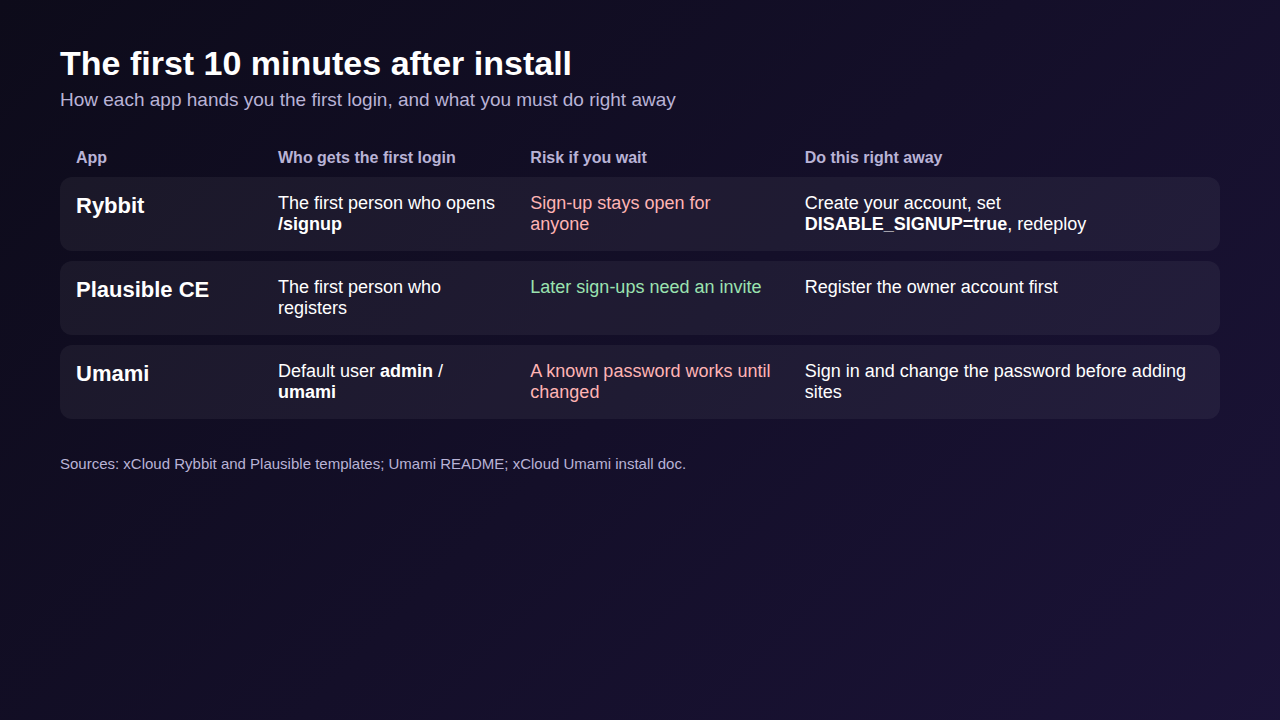
- Rybbit: the first person to open
/signupbecomes the owner, and sign-up stays open. Create your account, then open the site’s Environment page, set DISABLE_SIGNUP to true and click Save & Redeploy, so nobody else can sign up. - Plausible CE: the first person to register becomes the owner. xCloud turns off open sign-up when it installs Plausible, so after you register, anyone else needs an invite from you.
- Umami: a fresh install has the default login
adminwith the passwordumami. Change it before you add any website.
Rule of thumb: whichever you pick, create or secure the owner account in the same sitting as the install.
5. Licence
Rybbit and Plausible are AGPL-3.0: free to run, but if you change the code and offer it to others as a service, you must share your changes. Umami is MIT, the most relaxed of the three.
For running it on your own sites, the difference rarely matters. It matters if you plan to build a paid product on top.
Cloud Prices, If You Would Rather Not Self-Host
All three sell a hosted version. Here is the entry point for each, as of November 2026.
| Rybbit Cloud | Plausible Cloud | Umami Cloud | |
|---|---|---|---|
| Free plan | No, 7-day trial | No, 30-day trial | Yes: Hobby, 1 website, 100K events a month, 6 months of data |
| First paid plan | Standard, $13/month billed annually | Starter, one site | Pro, $20/month, 1 million events a month, up to 20 websites |
| Funnels and journeys | Included | Business plan and up | Same features as self-hosted (per Umami) |
| Session replay | Pro ($26/month billed annually) | Not listed on the pricing page | Business ($200/month) |
Sources: Rybbit pricing (read 7 November 2026), Plausible pricing and Umami pricing (read 10 November 2026). Cloud prices change often, so check them before you buy.
The honest take: for one small site, a cloud plan is cheaper than any server. Umami Cloud’s free plan is hard to beat for a hobby site. Self-hosting wins when you have many sites, teammates, or need the data on your own server.
Which Should You Self-Host?
| Your situation | Better fit | Why |
|---|---|---|
| Blog or brochure site | Umami | Smallest server, one database to back up |
| Agency with many client sites | Umami or Plausible | No per-site fees when self-hosted; simple reports clients can read |
| Marketing team that wants one screen | Plausible | The most readable dashboard of the three |
| SaaS or online store | Rybbit | Funnels, journeys and replay without a paid plan |
| Small server already running other apps | Umami | No ClickHouse to feed, and funnels still included |
Choose Rybbit if…
- ✅ You want session replay, autocapture or error tracking without paying for a cloud plan.
- ✅ You care about Web Vitals from real visits.
- ✅ You can give it a server with at least 2 GB of RAM. Rybbit’s minimum is 2 GB, but a new xCloud server for a Docker app starts at 4 GB.
Rybbit is the closest thing to a product-analytics suite on this list.
Choose Plausible if…
- ✅ You want traffic, sources and goals on one screen your whole team can read.
- ✅ You are fine without funnels and journeys when self-hosting.
- ✅ Two releases a year suits you.
Plausible is the calm, polished choice.
Choose Umami if…
- ✅ You want the smallest install and the fewest backups.
- ✅ You prefer the MIT licence.
- ✅ You want funnels and journeys on the smallest possible server.
Umami is the one you forget is running, in a good way.
Where Each One Falls Short
No tool here is perfect. Here is what to know before you switch.
- Rybbit is the youngest project and runs the most parts. Replay data adds up on disk, and the 3D globe map needs a Mapbox token that xCloud does not set for you.
- Plausible CE lacks funnels, journeys and ecommerce revenue, and gets new features only twice a year. Its bot filtering is also simpler: Plausible’s self-hosted comparison describes it as “basic bot filtering that targets the most common non-human traffic based on the User-Agent header and referrer spam domains”, against “advanced bot filtering” on its cloud.
- Umami lists session replay only on its Business cloud plan, and its default login is public knowledge until you change it.
- None of them imports your Google Analytics history in a way we have checked. Expect to start fresh.
How to undo it: each one runs beside your site, not inside it. Remove the script tag and your site is back to how it was.
Self-Host Rybbit, Plausible or Umami With xCloud
Here is what xCloud does today for these three apps, and what it does not.
What xCloud does:
- ✅ Deploys each one from New Site as a One Click App, on a server you own, with your domain and free SSL.
- ✅ Generates every password and secret for Rybbit and Plausible. Their databases are only reachable by the app, not from the internet.
- ✅ Gives Docker apps like Rybbit Backup Now and scheduled backups on paid plans. 👉 Back up and restore Docker apps
- ✅ Lets you change the Rybbit or Plausible version and click Save & Redeploy when you choose. For Umami, settings change on the Environment page with Update Environment. 👉 Update a One Click App
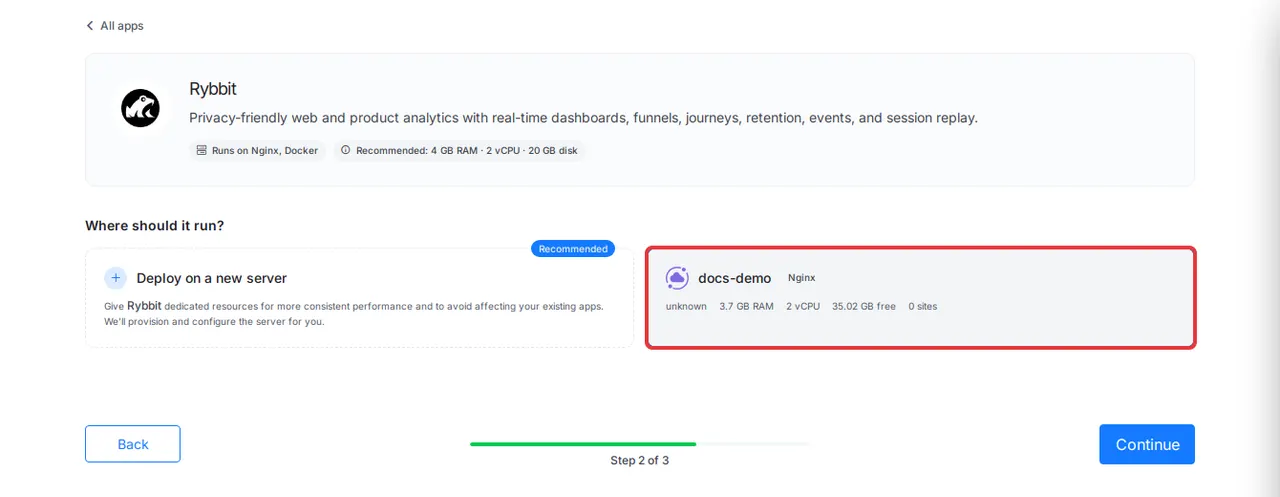
The Rybbit app page shows the stack it runs on and the recommended size before you deploy, and each server card shows its free RAM and disk.
What xCloud does not do:
- ❌ It does not create your Rybbit or Plausible login. You register the owner account yourself.
- ❌ It does not change Umami’s default password for you.
- ❌ It does not update the apps on their own; each app stays on the version you installed until you change it.
- ❌ It is not cheaper than a cloud plan for one small site. The Rybbit and Umami hosting pages start at $24.99/month on a 6 GB Cloud VPS; the Plausible page recommends the 16 GB plan at $59.99/month. Or you can connect a server you already rent.
- ❌ xCloud has no partnership with Rybbit, Plausible or Umami.
Step-by-step guides: 👉 Deploy Rybbit with xCloud · 👉 Install Umami with xCloud · 👉 Manage One Click App domains
Pick your app: Rybbit hosting, Plausible Analytics hosting or Umami hosting, or browse every analytics One Click App.
Pick Your Analytics Tool This Week
The choice is simpler than the feature lists suggest. Umami for the lightest install with funnels, Plausible for the cleanest dashboard, Rybbit for replay and the deepest reports.
This week, write down the one question you want your analytics to answer. “How many visitors?” points to Umami or Plausible. “Where do buyers drop off?” points to Umami or Rybbit. “What did they see before they left?” points to Rybbit. Then install it and secure the owner account in the same sitting.
Still weighing heavier tools? Read our OpenPanel vs PostHog breakdown, the Docker Compose explainer, or the trade-offs of self-managed vs managed hosting.
If you have found this blog helpful, feel free to subscribe to our blogs for valuable tutorials, guides, knowledge, and tips on web hosting and server management. You can also join our Facebook community to share insights and engage in discussions.
Frequently Asked Questions
Is Rybbit better than Plausible?
Rybbit does more; Plausible does less on purpose. Self-hosted Rybbit includes funnels, user journeys, session replay and Web Vitals, while Plausible Community Edition leaves funnels and journeys to its paid cloud. If you only need traffic numbers, Plausible’s single screen is easier to read.
Which is lighter to run: Rybbit, Plausible or Umami?
Umami. It runs as one app plus one database, and the README asks only for Node.js and PostgreSQL. Rybbit and Plausible both add ClickHouse, which needs more memory. xCloud asks for at least 2 GB of RAM for Rybbit and 4 GB for Plausible.
Are Rybbit, Plausible and Umami free?
Yes, when you self-host them. Rybbit and Plausible are licensed AGPL-3.0 and Umami is MIT, so you pay only for the server. Their hosted clouds are paid, except Umami Cloud’s Hobby plan, which is free for 1 website and 100K events a month (checked November 2026).
Do these tools need a cookie banner?
All three say they track without cookies. Whether your site still needs a banner depends on everything else your pages load and on your local law, so check with whoever signs off your privacy policy.
Can I run Rybbit, Plausible and Umami on WordPress sites?
Yes. Each one gives you a script tag to paste into the head of your site, with your theme’s header settings or a header-code plugin. If you use a speed or caching plugin, copy Rybbit’s script version that has your site ID in the link, because some of these plugins strip settings from script tags.
Can I switch from one to another later?
Yes, but plan for a fresh start. Each tool stores visits in its own format, so history does not carry over by default. Run the new tool beside the old one for a few weeks, then remove the old script.