Cloud VPS 6 GB
Most popularA log and observability backend for one team or project.
$24.99per month
- 6 GB RAM
- 4 vCPU cores
- 100 GB NVMe SSD
- 30 TB
- Unlimited

Parseable hosting on xCloud lets you deploy Parseable, an open source log management and observability platform, and keep your logs, metrics and traces on your own server. xCloud runs the pinned Parseable 3.2.5 image as a single container, generates the admin password, mounts volumes for stored data and staging, and publishes the console and API over HTTPS. You send events over HTTP or OpenTelemetry and query them with SQL.
Parseable is an open source, columnar data lake platform that upstream describes as purpose built for observability. You send logs, metrics and traces through logging agents, OpenTelemetry, Kafka or plain HTTP, and query them with SQL from the built-in console, with alerting and dashboards in the same binary. A self-hosted Parseable keeps that data on infrastructure you run instead of a hosted service such as Datadog. It is licensed AGPL-3.0.
On xCloud the template runs Parseable 3.2.5 as a single container in local-store mode. The image is an xCloud rebuild of the upstream v3.2.5 tag, because upstream publishes no multi-architecture 3.x image, and it is pinned by digest. Datasets live on parseable_data and not-yet-stored events on parseable_staging. Object storage and multi-node setups are not part of this template.
A self-hosted log platform normally means a container, credentials, storage volumes, a domain and a certificate before the first event arrives. This is the same result without assembling any of it.
Step 01
Create your xCloud account and pick Parseable from the OneClick catalog. Choose your domain and target server — there are no extra fields to fill in.
Step 02
One click. We bring up the single Parseable container pinned by immutable digest, mount the parseable_data and parseable_staging volumes, generate the admin password, turn off anonymous usage telemetry and update checks, and publish the console and API over HTTPS on your domain.
Step 03
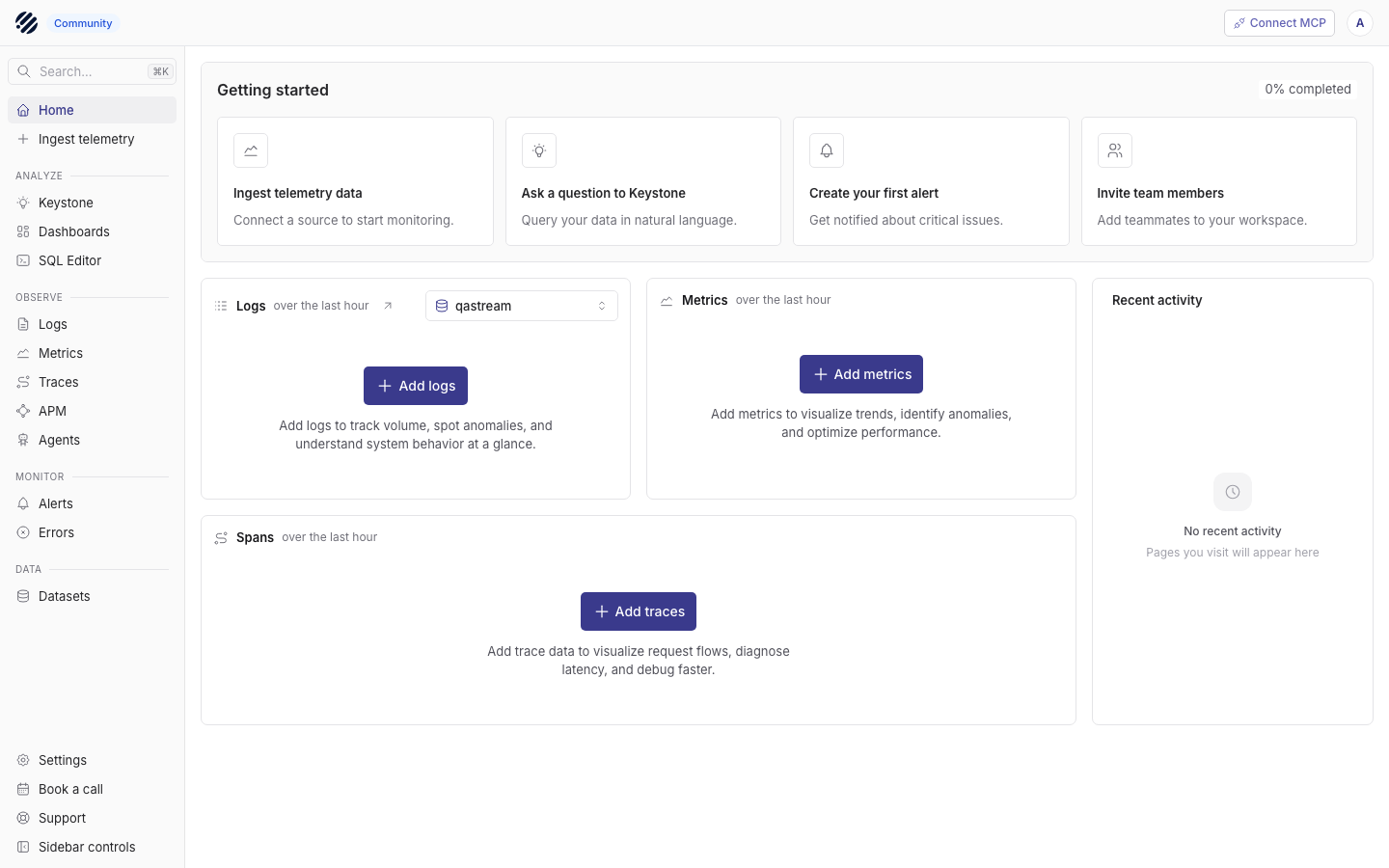
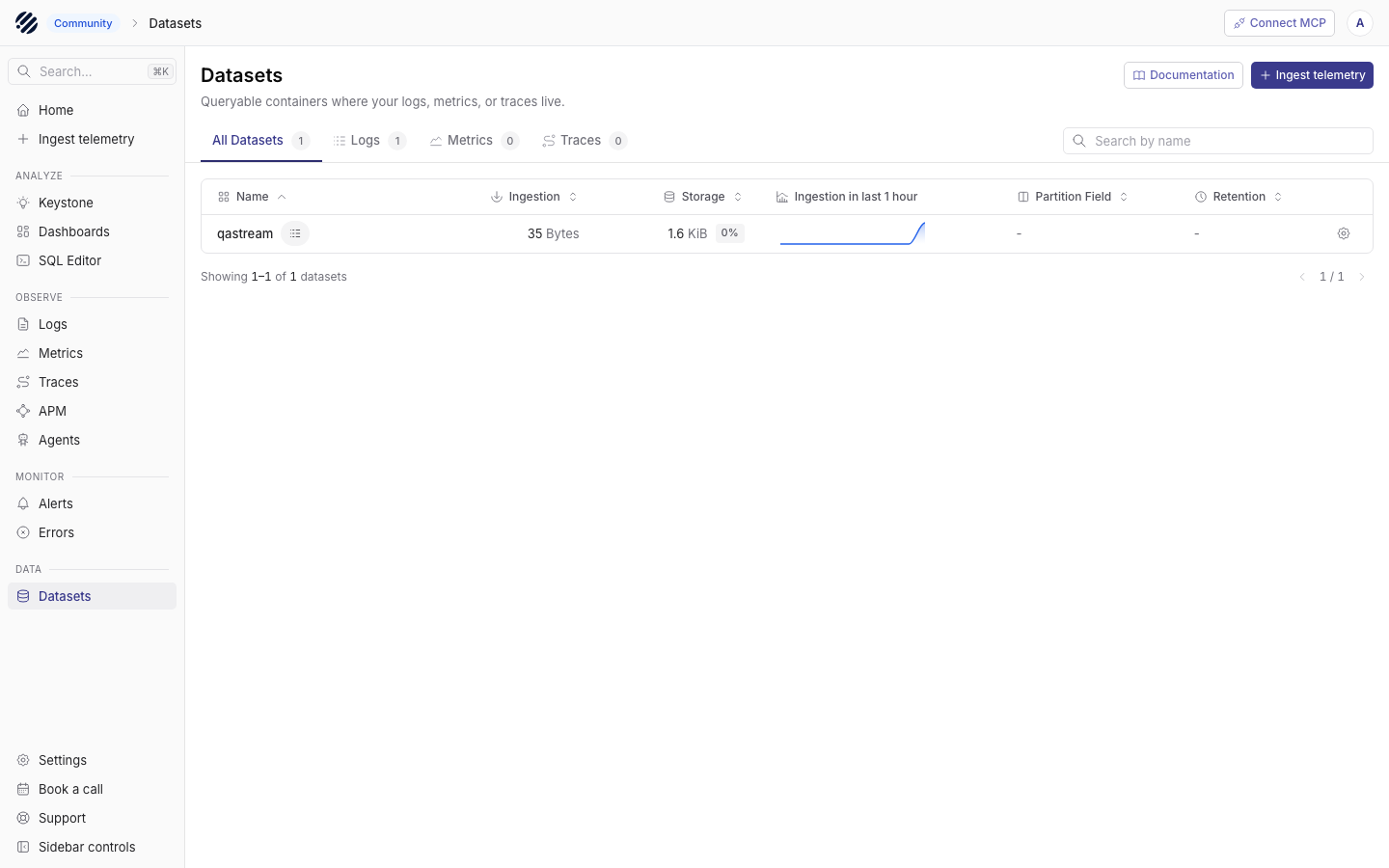
Save the admin password from the protected credentials and sign in as admin at your HTTPS URL. Then POST JSON to /api/v1/ingest with an X-P-Stream header naming the dataset, and open Datasets in the console to query it.
Parseable runs in full here: a log and observability backend with a built-in console, on your own domain and your own storage.
One platform ingests logs, metrics and traces, so observability data lands in a single place you control.
Query ingested data with SQL from the built-in console instead of learning a proprietary query language.
Send JSON events to /api/v1/ingest with an X-P-Stream header, or use the OpenTelemetry endpoint described in the Parseable docs.
Ingest and query requests without the generated admin credentials are rejected, so the instance is not an open endpoint.
This single-node setup keeps data on local volumes, so you can start without provisioning an S3-style bucket.
Anonymous usage telemetry and update checks are disabled by default in this template.
Managed hosting for Parseable, so the parts that keep it online are not your problem.
Ship JSON logs from your services to one dataset-based store on your own server and search them with SQL.
Point an OpenTelemetry pipeline at your instance to keep logs, metrics and traces off third-party platforms.
Start with the single-node local-store setup and no bucket to provision, then back up the volumes together.
Run the console and API on your own domain with generated credentials and data on volumes you own.
Dedicated Cloud VPS sizes, pre-configured for Parseable hosting. Pick the one that fits, and resize any time.
A log and observability backend for one team or project.
$24.99per month
More headroom for heavier ingest or other tools on the same server.
$59.99per month
Every size is a dedicated Cloud VPS we provision, patch, monitor and restore. Billed monthly with no lock-in — delete the server and the unused balance comes back to your account. Parseable itself is licensed by its maintainers under AGPL-3.0.
Connect any VPS — DigitalOcean, Vultr, Linode, AWS, Hetzner or bare metal — and deploy Parseable on it through the same panel, for a per-server management fee instead of a Cloud VPS rental.
Start your journey without cost.
$0forever
Your rate with 2–5 servers connected.
$5per server / month
The same platform, discounted at 6–10 servers.
$4per server / month
The same platform, discounted at 11+ servers.
$3per server / month
Priced per connected server, so your rate adjusts automatically as you add or remove servers. You pay your own provider for the server itself.
Parseable on xCloud runs on a dedicated Cloud VPS that we provision, patch, monitor and restore. Deploy faster. Own the server. Stay in control.

Deploy faster using an xCloud Managed Server built with optimized stacks and high-speed SSDs.

Protect your infrastructure with a free SSL certificate and more advanced security features at no additional cost.

From Server creation to application deployment, everything can be managed from our intuitive control panel.
See why agencies, developers, startups, and growing businesses choose xCloud to power their projects.
xCloud works really well, I am surprised by its performance being this the release version, I have tried many paid platforms such as runcloud, cloudpages or serveravatar, as well as free platforms such as CyberPanel, CloudPanel or Hestia Control Panel and direct competitors such as SpinupWP and FlyWP. Of all those that I have tried, the platform that works best for WordPress is SpinupWP and I believe that xCloud can reach and surpass that development, its roadmap is promising. Congratulations to the xCloud team, I hope they become the leading platform in the segment, it has all the potential to achieve it!
 Brian Geovanny
I've been with runcloud for the last 3 years. However, after trying xcloud for the last month, I'm switching over. They are on a roll with their setup.
 Kevin Pineda
I'm moving my servers to xCloud, a cloud control panel by M Asif Rahman and the WPDeveloper team. Their roadmap looks interesting and no, there are no team mates nor API limits with xCloud! #xCloud #wordpress #hosting
 Leo Koo
How Cloud Nine Web Elevated Client Experience While Streamlining Hosting Operations using xCloud
 Ed Ellingham
xCloud is like having an expert server team on call — without the big agency costs. It's given me back my time and given my clients peace of mind. Highly recommended for freelancers and small teams who want reliable performance and security.
 Dumitru Butucel
xCloud isn't just a solution. It's like one of that friend who got your back when you screw things up pretty bad.
 Waqar Ahmed
Trust me when I say, once people explore the potential of xCloud they gonna switch from other panels, just keep delivering the best tech, lots of love for the team 😍😍
 Rahul Singh
So far my experience has been smooth like silk. I didn't imagine that configuring and managing a VPS would be so easy. As of today, I have deployed 8 sites. The support is good, and they treat users with respect, even if they ask stupid questions (myself included). For the future, I hope for greater flexibility in scheduled backups and more comprehensive and consistent documentation. I'm sure that within a few months, xCloud will become the leader in its segment. This community is amazing, and the Staff here is super helpful.
 Massimo Villa
Came from cloudways then to runcloud then to xcloud. Looks like I'm staying here.
 Gerson El
I've recently taken all of my Vultr-hosted sites and gotten rid of cPanel for them to substitute it with xCloud. I have to say, I'm really impressed with xCloud so far! The interface is definitely the standout feature for me.
 Tony Lewis
I came from Cloudways and won't go back. Highly impressed with xCloud. Glad I gave them a chance.
 Jared McDowell
I like xCloud better than RunCloud, but one thing I'll point out is that some years ago RunCloud was hungry for business, the support was outstanding, and the community was active and helped each other. Maybe it was sold, there was a change in management, or they stopped being hungry, but the quality of the RunCloud offering declined and it hasn't been moving forward quickly. My point is that currently the xCloud team has the edge and it is theirs to keep or lose
 David McCan
How Kevin Heinrichs Cut Hosting Costs by 84% While Running WooCommerce & Node.js Sites Efficiently
 Kevin Heinrichs
I had 150 sites on cloudways and am in the process of moving them to xcloud. Much faster and better priced.
 Dan Spinoza
Dear xCloud Team, I have been using xCloud for some time now and am genuinely impressed with its capabilities and the flexibility it offers by allowing users to bring their own VPS for management. It's a fantastic service, and my experience so far has been very positive. Successful migrated 5 sites on a single server. Xcloud migration tool worked great. There were few hiccups with security plugin like MalCare but disabling the plugin prior to migration worked just fine.
 Rahil Maknojia
Came from runcloud. Tried xcloud and never came back.
 Karl Fanega
How Advanced Web Strategies Saved Over $2,000 & Recovered 56 Hours per Month Managing 70+ Client Websites
 Gary Moody
xCloud gave me what no other hosting platform could: the flexibility of a VPS with the convenience of managed WordPress. As a solo founder running an entire business on one server, that combination is an important unfair advantage.
 Jorge de los Reyes Martínez
I use Server Avatar and xCloud and I'll sooner use xCloud than Server Avatar personally.
 Jay Pagano
How Newman Web Solutions Ensured Perfect Uptime and Seamless Scaling For 120+ WordPress Sites with xCloud
 Lori Newman
I too have moved over to xCloud. It's pretty sweet. One click n8n and uptime Kuma apps
 John Aperture
I went from Cloudways to xCloud. No intention on switching in the foreseeable future.
 Blaine Moore
Feel free to contact us with any questions or concerns you may have.
Yes. Parseable is open source under the AGPL-3.0 licence, so the software carries no licence fee or per-gigabyte ingest charge from the project. You pay xCloud for the dedicated Cloud VPS and the disk your log volume consumes.
The manifest asks for 2 CPU cores, 512 MB of RAM and 10 GB of disk, and QA saw about 21 MiB idle. Memory and disk grow with what you ingest and query. The 6 GB plan is the entry rung and leaves room for real log volume.
Yes, and this template is Parseable Docker hosting without the setup: the xCloud-rebuilt 3.2.5 image pinned by digest as a single container, a generated admin password, two named volumes, and the console and API on one HTTPS domain.
POST JSON to /api/v1/ingest on your HTTPS URL with an X-P-Stream header naming the dataset and basic authentication using the admin login. The ingested data then appears under Datasets in the console, ready to query with SQL.
Yes. Upstream describes native OpenTelemetry support, so telemetry can be sent without custom plugins, and the Parseable docs describe the endpoint. Point your collector at your HTTPS domain with the admin credentials, and check the docs for the exact path.
No. Requests with missing or wrong credentials are rejected, so the instance is not an open endpoint. The generated admin password protects both the console and the API, so keep it private and rotate it if it leaks.
No. Anonymous usage telemetry and update checks are turned off in this template's default configuration, so the server does not report back or look for new releases on its own. Upgrades are a deliberate step you take.
Back up parseable_data, which holds stored datasets and metadata, together with parseable_staging, which holds events received but not yet moved to the store. Local storage lives on this server only, so keep a copy elsewhere.
The install stays on Parseable 3.2.5 until you adopt a newer template version. Back up both volumes first and read the upstream release notes. Nothing upgrades the app automatically, and a redeploy keeps the volumes and your datasets.
The admin username and password are read from the environment on every start. Edit them in the Environment editor and Save & Redeploy, then update any agent or collector that sends data with the old login.
This page is your own Parseable cloud: a dedicated Cloud VPS running the open-source platform, with datasets on volumes you control. One tenant, one node: you decide who gets the login and what is ingested.
Yes. There is no lock-in — cancel any time. Hosting is billed monthly and charged for what you actually use, so when you delete the server the unused balance is refunded to your account, less up to 10% in payment-processing fees.
 Beszel HubLightweight server and container monitoring hub with historical metrics, alerts, multi-user access, and OAuth/OIDC support. Agents are installed separately on monitored systems.
 BugsinkSelf-hosted error tracking that accepts events from the Sentry SDKs you already use, with teams, projects and a per-project DSN.
 changedetection.ioWatches any web page and alerts you when the part you care about changes, with visual selectors, diffs and notifications to dozens of services.
 CheckCleOpen-source monitoring platform for uptime, SSL and domain expiry, incident tracking and public status pages.
 CheckmateOpen-source uptime and infrastructure monitor with HTTP, ping, port, DNS and Docker checks, incident history and public status pages.
 CheckmkInfrastructure and application monitoring with automatic service discovery, alerting, dashboards and a REST API, in the Community Edition.
 DashbrrA self-hosted dashboard for monitoring and managing your media automation stack, with live real-time status for services like Sonarr, Radarr and Plex.
 Domain WatchdogSelf-hosted domain name monitor that uses RDAP to track registration history, expirations and status or ownership changes, with email, webhook, calendar and RSS alerts.
Connect your first server in minutes. No plan you have to grow into.
