
PostgreSQL Hosting Live In 5 Minutes
Deploy PostgreSQL hosting and get your own PostgreSQL database server on a dedicated Cloud VPS, without writing a compose file or choosing storage. xCloud runs a postgres:17-alpine container, generates a 24-character superuser password, creates your default database on a persistent volume and shows a connection string you can paste straight into your application. Your data stays on a server you own, and you choose who can reach the port.
- No terminal
- No technical skills needed
- No lock-in, cancel anytime
What is PostgreSQL?
PostgreSQL is an open-source object-relational database system that uses and extends SQL, with ACID transactions, JSON and JSONB types, extensions such as PostGIS and replication options. Run on a server you control, it is a self-hosted PostgreSQL database server and the alternative to a managed relational service such as Amazon RDS, with the data directory on a volume you own.
On xCloud it is deployed as one postgres:17-alpine container, tagged to major version 17 rather than pinned by digest. The superuser name, default database and a generated 24-character password come from the install form, and the pgdata volume keeps the data across restarts. It has no web page: the container's port 5432 is published on a host port for your applications.
From Sign-Up to a Live PostgreSQL In Just 3 Easy Steps
A PostgreSQL server normally means a container, a superuser, a default database, a data volume and a published port before the first query. This is the same result without assembling any of it.
Step 01
Sign Up
Create your xCloud account and pick PostgreSQL from the OneClick catalog. Choose the superuser name, the default database name and a password, or leave the password to be generated. There is no domain to set.
Step 02
We Deploy It For You
One click. We start the postgres:17-alpine image as a single container, mount the pgdata volume for the data directory, create the superuser and default database on first boot, and publish container port 5432 on a host port.
Step 03
Connect With psql
Copy the connection string from the credentials panel and run it with psql, then create a separate role for each application. The service has no web page: your own code connects to the host and port directly.
Everything PostgreSQL Does, On Your Own Server
PostgreSQL 17 runs in full here: one standalone database server whose data directory sits on a volume you own.
ACID Transactions
PostgreSQL has been ACID-compliant since 2001 and uses multi-version concurrency control, so concurrent writers and readers do not block each other on ordinary queries.
JSON And JSONB Storage
Store documents in JSON or JSONB columns next to ordinary tables, and query them with SQL/JSON path expressions and functions.
Contrib Extensions And Custom Types
The image ships PostgreSQL's contrib modules, so CREATE EXTENSION adds extra data types and functions, and you can define your own. PostGIS is not included in this image.
Replication Options
Upstream supports asynchronous, synchronous and logical replication, plus point-in-time recovery. This template runs one standalone instance and does not set any of that up.
Access Control And Row Security
Create a login role per application and grant it only the schemas and tables it needs; upstream also offers column and row-level security.
Full-Text Search
Search text inside the database with built-in full-text search and ICU collations, without running a separate search service.
Everything You Need To Run Your Database 24/7
Managed hosting for PostgreSQL, so the parts that keep it online are not your problem.
- PostgreSQL 17 deployed instantly
- Superuser password generated for you
- Connection string ready to copy
- Data on a persistent pgdata volume
- Server backups and snapshots
- Server security updates included
- 30+ server locations
- Unused balance refunded
What You Can Do With PostgreSQL
Give your app a transactional database
Point a web or API backend at one PostgreSQL server and keep orders, accounts and settings in ACID tables, with a login role per application instead of the superuser.
Store JSON documents beside relational tables
Keep flexible payloads in JSONB columns and query them with SQL, so a product can mix structured records and documents in the same database.
Search text without a separate search service
Use PostgreSQL's built-in full-text search and ICU collations to query articles, notes or product text in SQL, on a server that you size and own.
Move off a metered managed database
Dump the database from a managed service and restore it into your own PostgreSQL 17 server, then connect your applications to the new host and port.
PostgreSQL vs Alternatives
- Amazon RDS
- A managed relational database service from AWS, where the provider runs the database engine; here you run PostgreSQL yourself on your own xCloud server and decide the roles, firewall rules and upgrades.
- MySQL
- Another open-source relational database, available as its own OneClick app; choose PostgreSQL when your application wants its JSONB type, its extensions or its own SQL dialect.
- MariaDB
- A MySQL-compatible open-source relational database, also a OneClick app; choose PostgreSQL instead when you want its extension ecosystem and its own SQL dialect.
- MongoDB
- A document database that stores JSON-like documents natively; PostgreSQL keeps tables and joins as its core model and handles documents through JSON and JSONB columns.
Or Use Managed PostgreSQL On Your Nginx Server
Apart from this OneClick app, an xCloud Nginx server can run one managed PostgreSQL service for the sites on that server. You install it from the dashboard, manage it in pgAdmin, and pick PostgreSQL instead of MySQL when you create a Git site. Use the OneClick app when you want a database server of its own; use the managed service when your sites and their database live on the same server.
- One per Nginx server
- Each Nginx server runs one PostgreSQL 17 service that every PostgreSQL site on it shares. Install it when you create the server, or later from Management → Settings → Install a Service. The server needs Docker Engine 28 or newer.
- Private to the server
- The service is reachable only from the server itself, not by server IP and port from the internet.
- pgAdmin built in
- Enable pgAdmin from Management → Database. It opens over HTTPS with its own login, where you create databases and roles, run queries and export data.
- MySQL or PostgreSQL per site
- Node.js, PHP App and Laravel sites deployed from Git choose MySQL or PostgreSQL when you create them. With PostgreSQL, xCloud creates a database and login for the site and adds the connection details to the site's .env file.
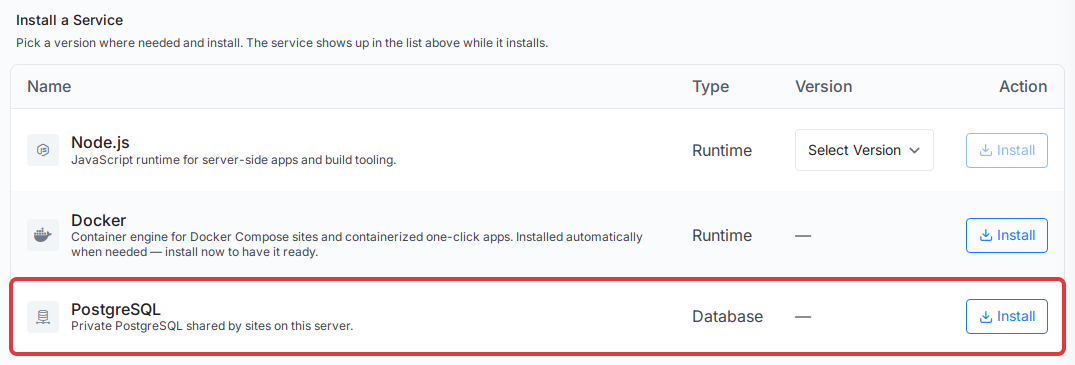
Current limits
- Nginx servers only. OpenLiteSpeed servers cannot install it, and a server that already runs this OneClick PostgreSQL app cannot add it.
- PostgreSQL databases are not in xCloud site backups yet. Export them from pgAdmin.
- PostgreSQL sites cannot be cloned, migrated, staged or snapshotted yet.
- Deleting a site keeps its PostgreSQL database and role. Remove them in pgAdmin if you no longer need them.
Ready To Own Your Database?
PostgreSQL on xCloud runs on a dedicated Cloud VPS that we provision, patch, monitor and restore. Deploy faster. Own your data. Stay in control.

Fast Provisioning
Deploy faster using an xCloud Managed Server built with optimized stacks and high-speed SSDs.

Enterprise-grade security
Protect your infrastructure with a free SSL certificate and more advanced security features at no additional cost.

Intuitive Control Panel
From Server creation to application deployment, everything can be managed from our intuitive control panel.
Hear what people are saying about us
See why agencies, developers, startups, and growing businesses choose xCloud to power their projects.
xCloud works really well, I am surprised by its performance being this the release version, I have tried many paid platforms such as runcloud, cloudpages or serveravatar, as well as free platforms such as CyberPanel, CloudPanel or Hestia Control Panel and direct competitors such as SpinupWP and FlyWP. Of all those that I have tried, the platform that works best for WordPress is SpinupWP and I believe that xCloud can reach and surpass that development, its roadmap is promising. Congratulations to the xCloud team, I hope they become the leading platform in the segment, it has all the potential to achieve it!
 Brian Geovanny
I've been with runcloud for the last 3 years. However, after trying xcloud for the last month, I'm switching over. They are on a roll with their setup.
 Kevin Pineda
I'm moving my servers to xCloud, a cloud control panel by M Asif Rahman and the WPDeveloper team. Their roadmap looks interesting and no, there are no team mates nor API limits with xCloud! #xCloud #wordpress #hosting
 Leo Koo
How Cloud Nine Web Elevated Client Experience While Streamlining Hosting Operations using xCloud
 Ed Ellingham
xCloud is like having an expert server team on call — without the big agency costs. It's given me back my time and given my clients peace of mind. Highly recommended for freelancers and small teams who want reliable performance and security.
 Dumitru Butucel
xCloud isn't just a solution. It's like one of that friend who got your back when you screw things up pretty bad.
 Waqar Ahmed
Trust me when I say, once people explore the potential of xCloud they gonna switch from other panels, just keep delivering the best tech, lots of love for the team 😍😍
 Rahul Singh
So far my experience has been smooth like silk. I didn't imagine that configuring and managing a VPS would be so easy. As of today, I have deployed 8 sites. The support is good, and they treat users with respect, even if they ask stupid questions (myself included). For the future, I hope for greater flexibility in scheduled backups and more comprehensive and consistent documentation. I'm sure that within a few months, xCloud will become the leader in its segment. This community is amazing, and the Staff here is super helpful.
 Massimo Villa
Came from cloudways then to runcloud then to xcloud. Looks like I'm staying here.
 Gerson El
I've recently taken all of my Vultr-hosted sites and gotten rid of cPanel for them to substitute it with xCloud. I have to say, I'm really impressed with xCloud so far! The interface is definitely the standout feature for me.
 Tony Lewis
I came from Cloudways and won't go back. Highly impressed with xCloud. Glad I gave them a chance.
 Jared McDowell
I like xCloud better than RunCloud, but one thing I'll point out is that some years ago RunCloud was hungry for business, the support was outstanding, and the community was active and helped each other. Maybe it was sold, there was a change in management, or they stopped being hungry, but the quality of the RunCloud offering declined and it hasn't been moving forward quickly. My point is that currently the xCloud team has the edge and it is theirs to keep or lose
 David McCan
How Kevin Heinrichs Cut Hosting Costs by 84% While Running WooCommerce & Node.js Sites Efficiently
 Kevin Heinrichs
I had 150 sites on cloudways and am in the process of moving them to xcloud. Much faster and better priced.
 Dan Spinoza
Dear xCloud Team, I have been using xCloud for some time now and am genuinely impressed with its capabilities and the flexibility it offers by allowing users to bring their own VPS for management. It's a fantastic service, and my experience so far has been very positive. Successful migrated 5 sites on a single server. Xcloud migration tool worked great. There were few hiccups with security plugin like MalCare but disabling the plugin prior to migration worked just fine.
 Rahil Maknojia
Came from runcloud. Tried xcloud and never came back.
 Karl Fanega
How Advanced Web Strategies Saved Over $2,000 & Recovered 56 Hours per Month Managing 70+ Client Websites
 Gary Moody
xCloud gave me what no other hosting platform could: the flexibility of a VPS with the convenience of managed WordPress. As a solo founder running an entire business on one server, that combination is an important unfair advantage.
 Jorge de los Reyes Martínez
I use Server Avatar and xCloud and I'll sooner use xCloud than Server Avatar personally.
 Jay Pagano
How Newman Web Solutions Ensured Perfect Uptime and Seamless Scaling For 120+ WordPress Sites with xCloud
 Lori Newman
I too have moved over to xCloud. It's pretty sweet. One click n8n and uptime Kuma apps
 John Aperture
I went from Cloudways to xCloud. No intention on switching in the foreseeable future.
 Blaine Moore
Frequently Asked Questions
Feel free to contact us with any questions or concerns you may have.
Can I run PostgreSQL in Docker?
Yes, and this template is PostgreSQL Docker hosting done for you: it runs postgres:17-alpine as one container with the pgdata volume mounted and port 5432 published on a host port. You fill in a superuser name, database name and password; there is no compose file to write.
How much RAM does PostgreSQL need?
The template manifest asks for 512 MB of RAM, 1 CPU core and 2 GB of disk as a floor. This page sells the 6 GB tier, which is well above it. Large working sets, many connections and big indexes all push memory use up beyond that floor.
How do I connect to a self-hosted PostgreSQL database?
Copy the Connection String from the credentials panel, which has the form postgresql://user:password@host:port/database, and use it with psql or your application's driver. The host is the server's IP address and the port is the published host port, not 5432.
Does PostgreSQL support JSON?
Yes. Upstream lists JSON and JSONB among its data types, plus SQL/JSON constructors, query functions, path expressions and JSON_TABLE. Nothing extra is installed for this: the postgres:17-alpine image includes it, so you can create JSONB columns straight away.
Does PostgreSQL support replication?
Upstream does: asynchronous, synchronous and logical replication, with active standbys and point-in-time recovery. This template deploys a single standalone instance and configures none of it, so replicas or a standby would be something you set up yourself.
Is this the same as managed PostgreSQL on an Nginx server?
No. This page deploys PostgreSQL as its own one-click app on a server, reachable by IP and port. Separately, an xCloud Nginx server can run one managed PostgreSQL service that Node.js, PHP and Laravel sites on that server share. It is reachable only from the server itself, comes with pgAdmin, and gives each site its own database and role.
Is PostgreSQL free?
Yes. PostgreSQL is free and open source under the PostgreSQL Licence, so the software has no per-core or per-seat fee. What you rent is the server, with no database licence on top, and you can resize it when the data grows.
How do I back up a PostgreSQL database here?
Back up the pgdata volume, which holds the full data directory, indexes and WAL. For a logical dump the template README suggests running pg_dumpall inside the container. Nothing dumps the database on a schedule for you, so schedule your own backup and test a restore.
How do I upgrade PostgreSQL to a newer version?
The image is postgres:17-alpine, a tag that follows the latest patch within major 17 and is not pinned by digest. Moving to another major version, say 17 to 18, needs pg_upgrade after replacing the container, so back up first. Existing installs are not changed automatically.
Is the database exposed to the internet?
Yes: the template publishes the port on 0.0.0.0, so anyone with the credentials who can reach the server can connect. Restrict it with your firewall to known client IPs. TLS is not enabled in the template, so terminate it in your application or a proxy.
Is this PostgreSQL cloud hosting I can resize?
It is PostgreSQL on a dedicated Cloud VPS you can resize, so it behaves like PostgreSQL cloud hosting, but with a single container and no managed failover. You change the plan for more RAM or disk, and the pgdata volume stays on the same server.
Should my applications use the superuser?
No. The superuser from the install form is for administration. Create one login role per application from psql, grant it CONNECT on the database and only the schema and table privileges it needs, and give each app its own password.
Can I cancel anytime?
Yes. There is no lock-in — cancel any time. Hosting is billed monthly and charged for what you actually use, so when you delete the server the unused balance is refunded to your account, less up to 10% in payment-processing fees.
More Databases apps in one click
Browse all Database apps →Browse all one-click apps → AdminerSingle-file web console to browse, query, edit and export MySQL, MariaDB, PostgreSQL and SQLite databases you already run.
 Apache CouchDBA document database that speaks HTTP and stores JSON, with multi-master replication that syncs to other CouchDB nodes and to PouchDB running in the browser.
 Apache SolrAn enterprise search and indexing server with faceting, rich document handling and a JSON API, behind an authenticated admin interface.
 ArangoDBA multi-model database that stores graphs, JSON documents and key-value data and queries them all with one language, AQL, behind a generated root password.
 ArcadeDBOpen-source multi-model database for graph, document, key-value, full-text, vector, geospatial and time-series data, with an HTTP API and Studio.
 BaserowOpen-source no-code database and application builder for spreadsheet-style tables, forms and workflows.
 Cassandra ReaperRepair scheduling and management dashboard for Apache Cassandra clusters you already run, with a REST API and a login-protected web UI.
 ChartDBOpen-source database schema diagram editor. Import schema JSON, explore and edit an ERD, then export SQL, JSON, or an image without connecting ChartDB to your database.
 ChromaOpen-source vector database and search infrastructure for AI applications, semantic search, embeddings, and retrieval-augmented generation (RAG).

Ready to Own Your Database?
Connect your first server in minutes. No plan you have to grow into.