

What Is A Cron Job And How To Configure xCloud Cron Job?
Updated November 17, 2026 · 4 min read
You choose how a WordPress site runs its scheduled tasks in ‘Site Settings’ → ‘WP-Cron and xCloud-Cron’. New sites already use xCloud-Cron, so most sites need no change. If a plugin or health check says WP-Cron is disabled, that is expected on xCloud-Cron: the server is running those tasks instead.
What is a cron job?
A cron job is a task that a server runs on a schedule. WordPress uses scheduled tasks to publish scheduled posts, check for updates and send plugin emails.
WordPress and xCloud offer two ways to run these tasks:
| Option | What runs the tasks | When they run |
|---|---|---|
| WP-Cron | WordPress | When someone visits the site |
| xCloud-Cron | Your server | On the interval you choose |
WP-Cron depends on visits, so a quiet site can run its tasks late. xCloud-Cron runs them on a fixed schedule, whether or not anyone visits.
Step 1: Open Site Settings
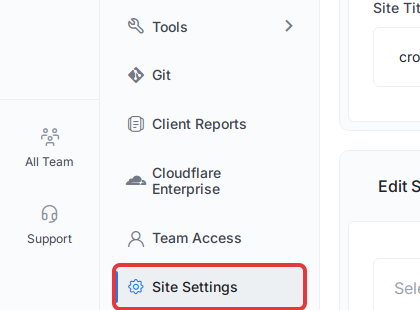
Open your WordPress site in xCloud and click ‘Site Settings’ at the bottom of the left menu. The ‘WP-Cron and xCloud-Cron’ card appears on the page.
Step 2: Select xCloud-Cron
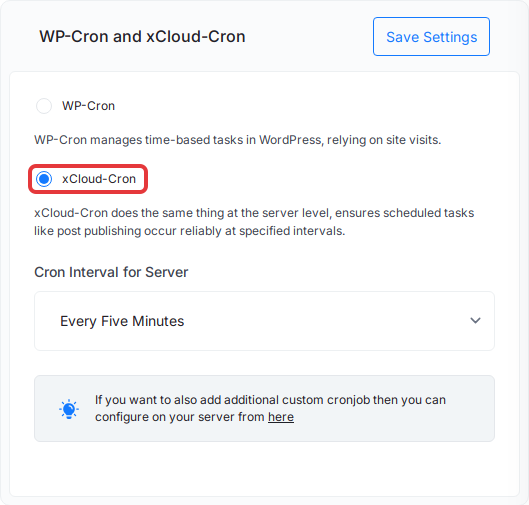
In the ‘WP-Cron and xCloud-Cron’ card, select ‘xCloud-Cron’. The ‘Cron Interval for Server’ menu appears under the two options.
Step 3: Choose the cron interval
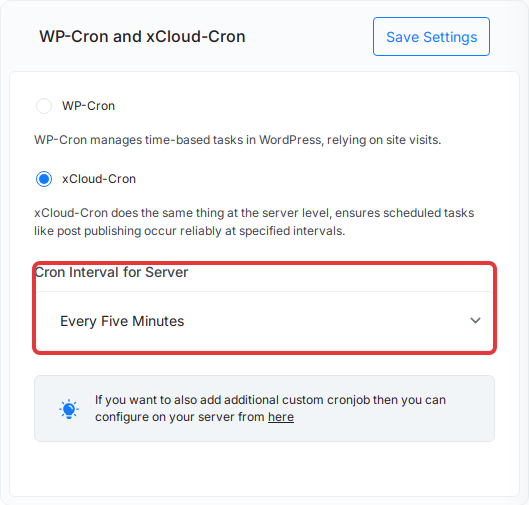
Pick how often the server should run tasks that are due. Use the ‘Cron Interval for Server’ menu. The default is ‘Every Five Minutes’.
The other choices are ‘Every Minute’, ‘Every Ten Minutes’, ‘Every Fifteen Minutes’, ‘Every Thirty Minutes’, ‘Hourly’ and ‘Random’. ‘Random’ runs once a day at a time xCloud picks.
Step 4: Save your settings
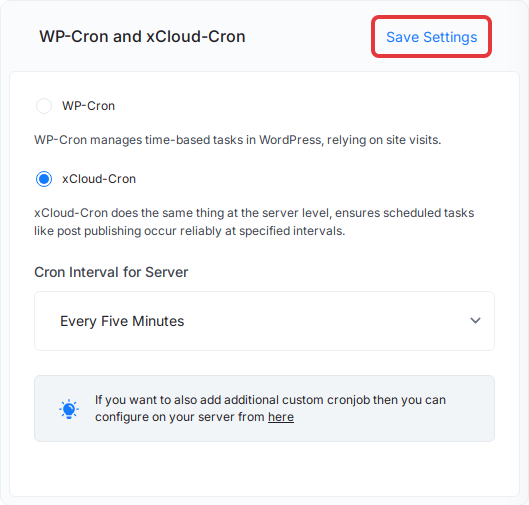
Click ‘Save Settings’ at the top of the card. xCloud updates the site’s wp-config.php file and the server schedule. You see ‘WP Cron updated successfully’. The change can take a little while to take effect.
The button is unavailable while the server is disconnected or the site is disabled. Reconnect the server or enable the site first, then save again.
Step 5: Check the saved schedule
Go to ‘Tools’ → ‘Cron Jobs’ in the same left menu. The notice ‘xCloud-managed WP-Cron is configured’ shows the interval you saved. xCloud runs this schedule while the site is enabled.
xCloud keeps this schedule hidden, so it doesn’t appear as a row in the ‘Cron Jobs’ list. An empty list is normal.

Why WordPress says WP-Cron is disabled
This notice is expected when your site uses xCloud-Cron. When you save xCloud-Cron, xCloud adds this line to wp-config.php:
define( 'DISABLE_WP_CRON', true );That line stops WordPress from running tasks on site visits, because the server now runs them on your interval. Without it, both would run the same tasks. So a plugin or health check that reads this setting can report that WP-Cron is disabled even though your tasks run normally.
Don’t remove the line by hand. To go back to the WordPress default, select ‘WP-Cron’ in Site Settings and click ‘Save Settings’. xCloud then removes the line and the server schedule for you.
The notice does point to a problem if no cron is running: the line is in wp-config.php but the site isn’t using xCloud-Cron and has no cron job of its own. Nothing runs your tasks in that case. Select ‘xCloud-Cron’ and save to fix it, or add your own site or server cron job.
When scheduled tasks still don’t run
WordPress reports a real problem in ‘Tools’ → ‘Site Health’ in your WordPress admin. ‘A scheduled event has failed’ or ‘A scheduled event is late’ means tasks aren’t finishing, which is different from the disabled notice.
Work through these checks:
- Check the site is not disabled. Turning on ‘Also Disable Cron For This Site’ with ‘Disable Site’ pauses the site’s scheduled tasks.
- Look for plugin or theme errors. An error in a plugin or theme can stop a run before later tasks finish. Turn on WP Debug and check your site logs.
- Run the tasks by hand. Connect over SSH as the site user and run these commands. Use your own domain in place of example.com. An error here can point to the cause.
cd /var/www/example.com
wp cron event run --due-now- Remove duplicate cron jobs. If ‘Tools’ → ‘Cron Jobs’ warns that a visible job also runs WordPress scheduled events, delete the job unless you added it on purpose.
Add your own cron jobs
xCloud-Cron only runs WordPress scheduled tasks. To run your own command on a schedule, follow how to add a custom cron job in xCloud. To see every job on a server, use the cron job list. To run a command once from a script instead, run and track site commands with the xCloud Public API.
Frequently asked questions
Why does my site say WP-Cron is disabled?
Because the site uses xCloud-Cron. xCloud sets DISABLE_WP_CRON to true in wp-config.php so the server runs your scheduled tasks instead of site visits. The notice is expected and you don’t need to change anything.
Do I need to add DISABLE_WP_CRON to wp-config.php myself?
No. xCloud adds it when you save xCloud-Cron and removes it when you save WP-Cron.
Which cron option does a new WordPress site use?
New WordPress sites start on xCloud-Cron with the Every Five Minutes interval. You can change both in Site Settings.
Why can’t I find the WP-Cron and xCloud-Cron card?
The card only appears on WordPress sites, under Site Settings, and only for team members who can manage that site’s settings. Ask your team owner if the card is missing.
If you run into any issues with cron jobs, feel free to reach out to our support team.