

How to Manage WordPress Updates Easily with Updates Manager
Updated November 9, 2026 · 6 min read
The Updates Manager lets you update WordPress plugins, themes and core on all your sites from one screen, without logging in to each site. xCloud checks every WordPress site for updates once a day, shows PRO plugin and theme updates next to free ones, tells you which updates can’t run and why, and keeps a history of every update.
The Updates Manager is available on paid plans.
Step 1: Open the Updates Manager
Log in to your xCloud dashboard and click Settings in the left sidebar. In the Settings menu, click Updates Manager under Fleet.
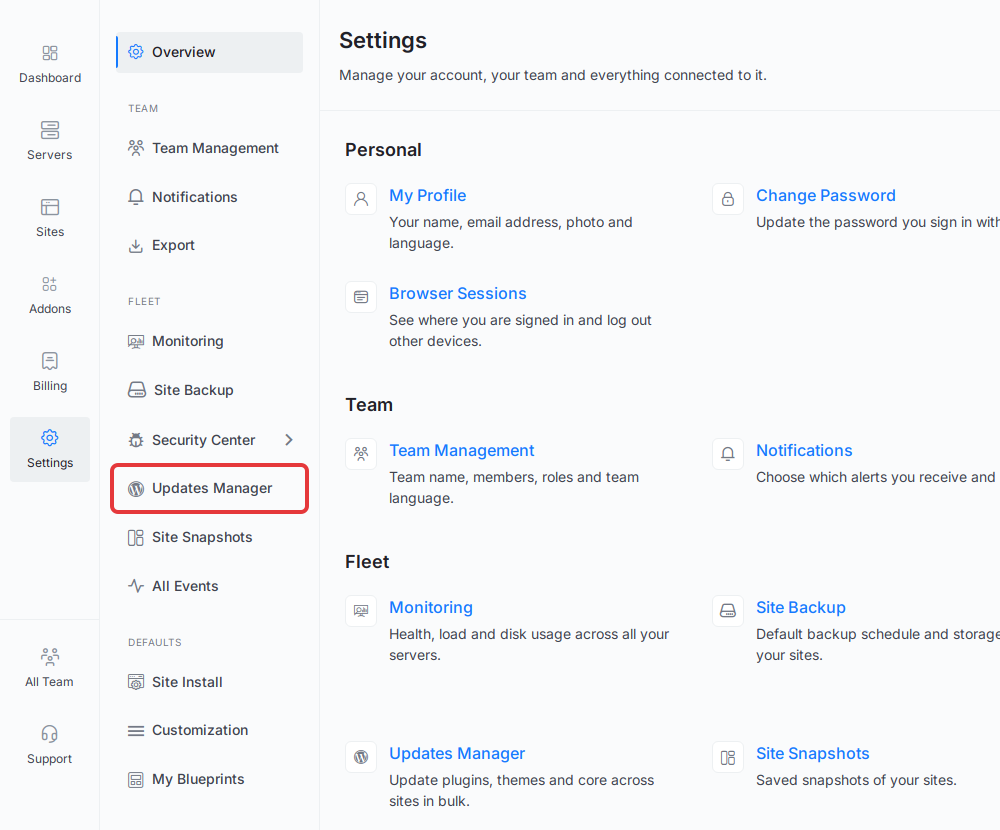
At the top you see four counts: Updates Available, Plugins, Themes and WordPress Core. On the left are Plugins, Themes, WordPress Core and Update History. Click one to see its items.
Step 2: Find the updates you want
Click Plugins (or Themes), then open the Update Available tab. Each item shows the number of sites it is installed on. Use All Servers, All Sites and Search to narrow the list. Updates that need a licence are kept in their own Licence needed tab, next to Update Available.
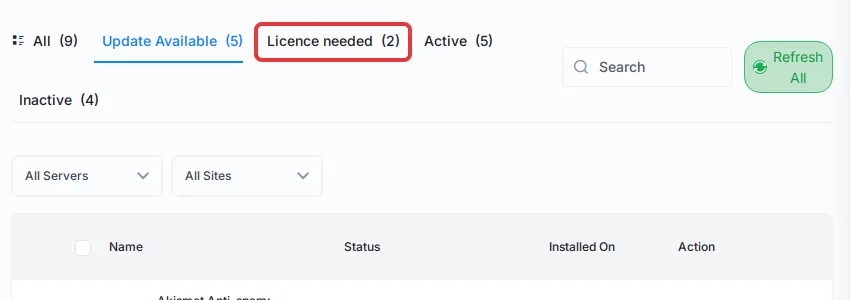
xCloud checks your sites once a day. If you just changed something in wp-admin, click Refresh All to check again now.
Step 3: Check PRO, Licence needed and Not compatible items
Some updates need your attention before they can run. The Updates Manager marks them so you can see them at a glance:
- PRO: a plugin or theme that does not come from wordpress.org, such as a premium plugin. Its updates show in xCloud whenever WordPress shows them in wp-admin.
- Licence needed: the vendor offers a new version but does not send the download, usually because the licence has expired or is not activated on that site. These updates are left out of the Updates Available count, which shows them apart (for example “2 need a licence”), and have their own Licence needed tab. Renew or activate the licence, or check the vendor’s own updater, then click Refresh All.
- Not compatible: the new version needs a newer WordPress or PHP version than the site runs. Its Update button can’t be clicked. Hover over it, or read the line under the badge, to see why (for example “Needs PHP 8.5 (site runs 8.3).”).
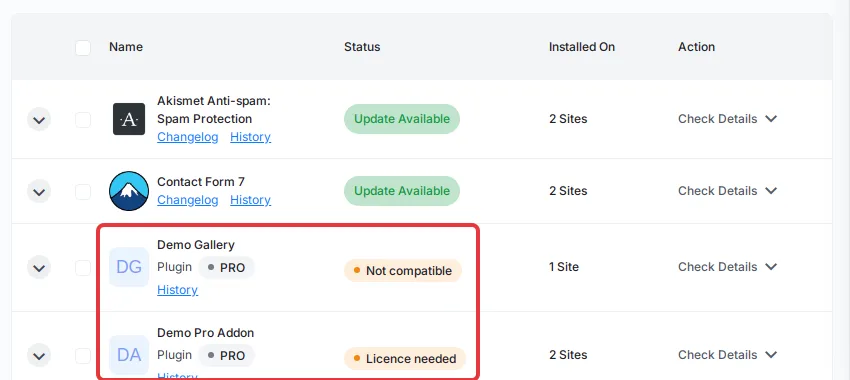
To fix a Not compatible update, update WordPress or the site’s PHP version first, then click Refresh All.
Step 4: Select items and click Update Selected
Tick the items you want, or tick the box at the top of the list to select all of them. Expand an item with the arrow on the left to pick only some of its sites. Then click Update Selected.
If you select all, Update Selected skips Licence needed and Not compatible updates. The update dialog tells you how many it skips.
Step 5: Review the update dialog and confirm
The dialog lists what will update, with the version change and the number of sites. A yellow note says what will be skipped, for example “4 will update · 2 need a licence · 1 not compatible”.
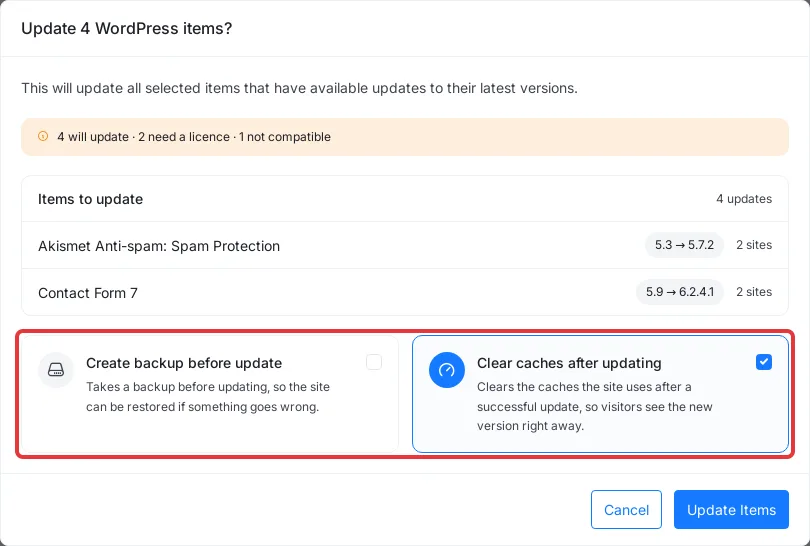
Choose your options, then click Update Items:
- Create backup before update: takes a backup of each site before updating, so you can restore it if something goes wrong.
- Clear caches after updating: on by default. Clears the site’s caches after a successful update, so visitors see the new version right away.
xCloud starts the updates on the selected sites. While they run, the item shows Updating… with the number of sites.
Step 6: Check the result in Update History
Click Update History on the left. Each update run shows when it ran and a summary such as “4 updated”, with each plugin, theme or WordPress update, the number of sites, who started it and whether it worked. Click See Details to see each site.
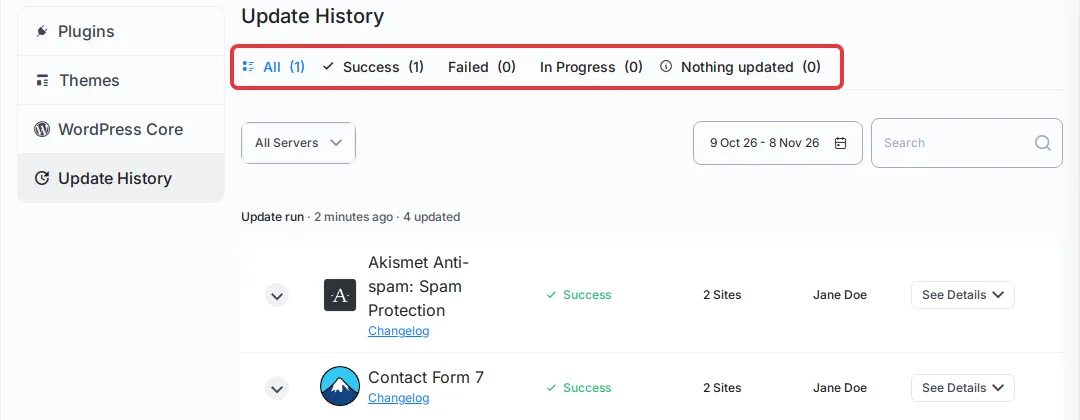
Use the tabs to filter: All, Success, Failed, In Progress and Nothing updated. A run lists the items it skipped with the reason, such as Licence needed, Not compatible, Already updating or No update available. When every item in a run was skipped, the run is marked Nothing updated.
Step 7: See the history of one plugin or theme
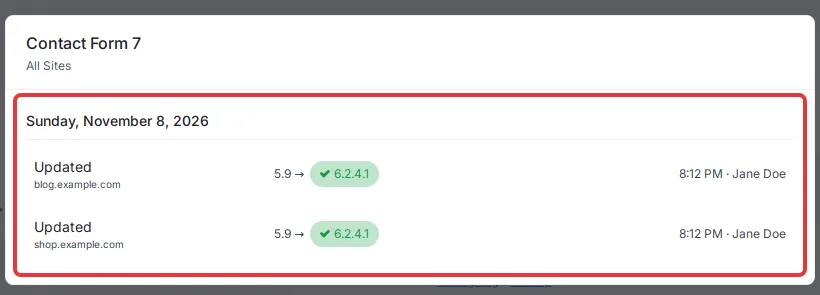
Click History under a plugin or theme name to see every update and rollback of that item on your sites, with the date, the version change, the site and who ran it.
Update one site from its Updates page
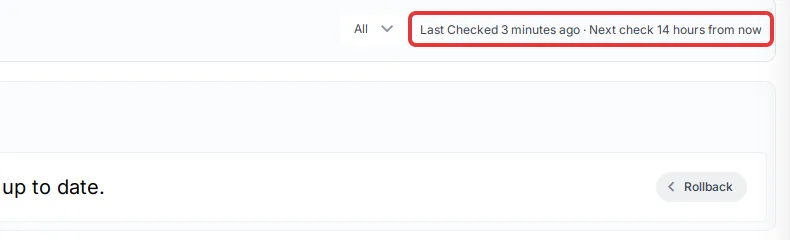
To update a single site, open the site and go to WordPress → Updates. The top of the page shows when xCloud last checked the site and when the next check runs. PRO, Licence needed and Not compatible items are marked the same way as in the Updates Manager.
When you update from this page, you can tick Take a backup first (the update waits for it) if the site has backups set up. The page then shows each stage as it runs: Backing up, Updating, Clearing cache and Finishing up. These updates also appear in the Updates Manager’s Update History. For rollbacks and activating plugins on one site, see how to manage and update WordPress core, themes and plugins.
If an update fails, see how to fix WordPress updates not working. To find sites with known vulnerable plugins first, see the Security Center guide and the vulnerability checker.
Frequently asked questions
Where is the Updates Manager in xCloud?
Click Settings in the left sidebar of the xCloud dashboard, then click Updates Manager under Fleet.
Can I use the Updates Manager on the free plan?
No. On the free plan, Updates Manager is locked in the Settings menu and does not open. It is available on paid plans.
Why does a PRO plugin show Licence needed?
The plugin’s vendor offers a new version but does not send the download, which usually means the licence on that site has expired or is not activated. Renew or activate the licence, or check the vendor’s own updater, then click Refresh All.
How often does xCloud check my sites for updates?
xCloud checks every WordPress site for updates once a day. To check right away, click Refresh All in the Updates Manager or Refresh on a site’s Updates page.
If you run into any issues, feel free to reach out to our support team.