

How to Configure Your Email Client with xCloud Mailbox Addon
Updated October 30, 2026 · 4 min read
You can read and send email from a paid xCloud mailbox in any email client, such as Outlook, Apple Mail, Thunderbird, Gmail or your phone’s mail app. The connection settings are on the mailbox’s POP, IMAP and SMTP tabs in xCloud.
Free mailboxes are webmail-only. A free 100 MB mailbox can’t connect to an email client. Its POP, IMAP and SMTP tabs show a message instead of settings. Upgrade the mailbox first, or read your email in webmail.
Before you start
- A mailbox. If you don’t have one yet, follow How to Set Up xCloud MailBox Addon.
- A paid mailbox plan. Free mailboxes don’t include IMAP, POP or SMTP access (see Step 1).
- The mailbox password. xCloud never shows a stored password. If you don’t know it, reset the mailbox password first.
- Verified DNS records. A new mailbox stays pending until its DNS records are verified, and a pending mailbox rejects every login.
Step 1: Check that your mailbox is on a paid plan
Go to Addons → MailBox, open your mailbox, and click the POP tab.
If the tab shows “Free mailboxes are webmail-only. Connecting an email client with IMAP, POP3 or SMTP needs a paid mailbox plan. Upgrade this mailbox to use these connection settings.”, the mailbox is on the free plan. The IMAP and SMTP tabs show the same message. You have two choices:
- Click Upgrade Mailbox and pick a paid plan. The same address then gets the connection settings described below, and you can continue with Step 2.
- Click Access Webmail to read and send email in your browser instead. This button appears once the mailbox is active.
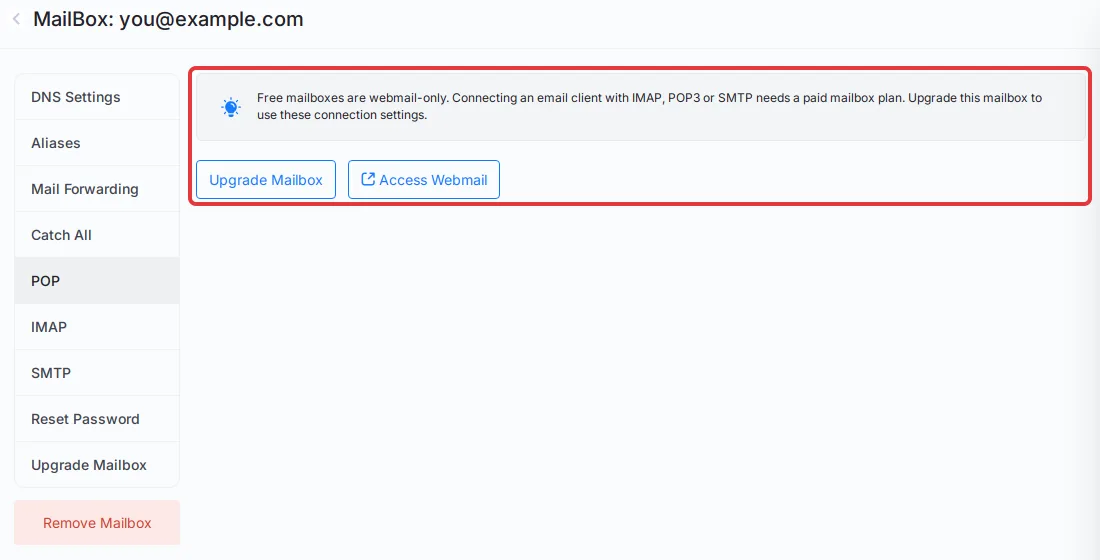
If the tab shows server names, ports and copy buttons instead, your mailbox is on a paid plan. Go to Step 2.
Step 2: Choose IMAP or POP
Choose how your email client downloads messages:
- IMAP is the right choice for most people. It keeps your email client and the server in sync, so reading, moving or deleting a message shows up on every device.
- POP downloads messages to one device. Changes you make there don’t sync to your other devices. Use it only if you read email on a single device and want to keep messages locally.
Step 3: Copy the connection settings
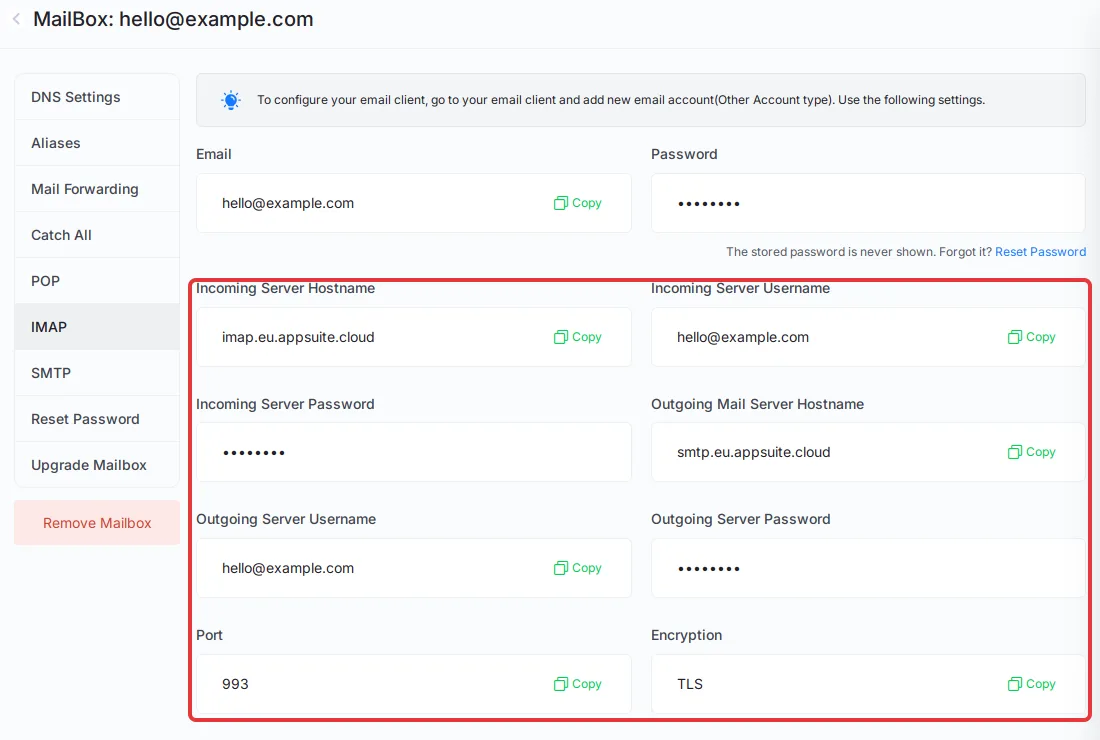
Open the IMAP or POP tab of your mailbox. Each value has a Copy button, so you don’t have to type it.
For IMAP, the tab shows:
| Setting | Value |
|---|---|
| Email and all usernames | Your full mailbox address, for example [email protected] |
| Incoming Server Hostname | As shown on the tab, for example imap.eu.appsuite.cloud |
| Outgoing Mail Server Hostname | As shown on the tab, for example smtp.eu.appsuite.cloud |
| Port | 993 |
| Encryption | TLS |
For POP, the incoming server changes and the port is 995:
| Setting | Value |
|---|---|
| Email and all usernames | Your full mailbox address |
| Incoming Server Hostname | As shown on the tab, for example pop.eu.appsuite.cloud |
| Outgoing Mail Server Hostname | As shown on the tab, for example smtp.eu.appsuite.cloud |
| Port | 995 |
| Encryption | TLS |
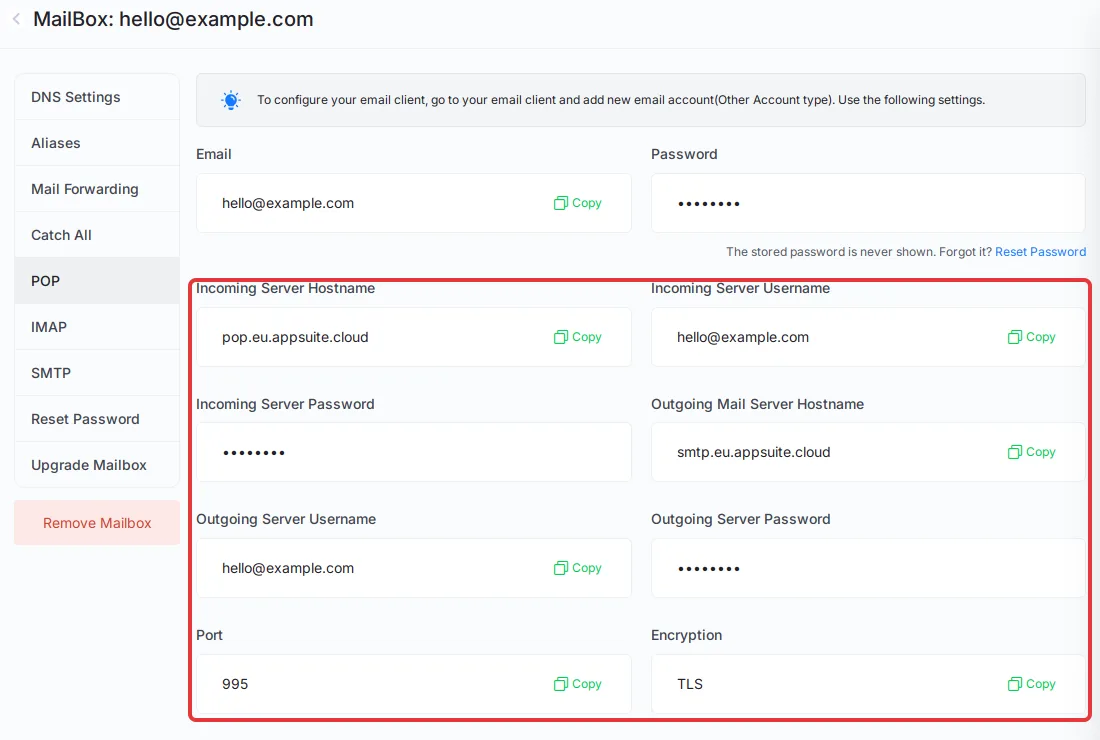
The server names depend on where your mailbox is hosted, so always copy them from your own tab. The examples above are from a mailbox in the EU region.
The Password fields show dots. xCloud never displays a stored password. Use the password you set. If you don’t know it, click Reset Password under the field to set a new one (the mailbox’s creator and the team’s owner and admins see this link).
For sending, the SMTP tab lists the outgoing server, the SSL/TLS port, the STARTTLS port and the encryption. A mailbox can send up to 250 messages a day through SMTP.
Step 4: Add the account in your email client
In your email client, add a new account and choose the manual or “Other” account type. Enter the values from Step 3. Use your full email address as every username.
Each email client has its own screens. These guides walk through the common ones:
For another email client, look for its “add account manually” or “IMAP account” setup and enter the same values.
Expected result: your email client signs in and downloads your messages. Send yourself a test email to check that sending works too.
If the login fails
- The mailbox is pending DNS verification. No password works until the DNS records are verified.
- The mailbox is on the free plan. IMAP, POP and SMTP logins are rejected even when webmail works.
xCloud Mailbox Login Fails? DNS Verification and Free Plan Limits Explained shows how to tell the two apart and fix each one.
For developers: Public API
The Public API’s mailbox connection endpoints, GET /api/v1/addons/mailbox/{mailbox}/pop, /imap and /smtp, follow the same rule. For a free mailbox they return webmail_only: true with a webmail_url and a message, instead of host, port and encryption. For a paid mailbox they return webmail_only: false with the connection settings.
Frequently asked questions
Can I connect a free mailbox to Outlook, Apple Mail or my phone?
No. Free mailboxes are webmail-only. Their POP, IMAP and SMTP tabs show a message instead of connection settings. Click Upgrade Mailbox to move it to a paid plan, and the same address gets IMAP, POP and SMTP settings.
Why does the Password field only show dots?
xCloud never shows a stored mailbox password. If you don’t know it, click Reset Password under the field, set a new one, and use that in your email client.
Should I use IMAP or POP?
Use IMAP if you read email on more than one device, because it keeps every device in sync with the server. Use POP only if you read email on one device and want to keep messages there.
If you run into any issues, feel free to reach out to our support team.